
Final Fantasy a Casual Retrospective Part VI

I have a confession to make; I wasn’t looking forward to Final Fantasy VI. Not because I heard it’s bad, quite the opposite. Final Fantasy VI is one of the most beloved RPGs of the 16-bit era. It regularly features in top ten lists for best SNES game, best RPG’s and best game in the Final Fantasy series where it usually sits in at least the top five. And that makes me a little intimidated.
It’s not just its classic status that makes me afraid. See I already played Final Fantasy VI years ago. I got it on the PSN store due to hearing all the positive things about it, and I didn’t like it. Yeah, I didn’t really enjoy the game when I first played it. I didn’t finish it, I only played through the first few hours, but something about it just didn’t grab me. I just couldn’t get into it.
You can see my issue right. I’m going into one of the most well-loved games in the series, with a history of not enjoying it. Granted that was years ago and I am a much more open-minded person now, but what if I don’t like it again. I can’t talk shit about this game I’ll get crucified for it.
Before I get into the game though, let’s talk about some behind the scenes stuff. Development of Final Fantasy VI started not long after the completion of Final Fantasy V in 1992. The game only took a year to complete, owing largely to its thirty-man development team. Which may not sound that impressive now, but that was a large team for the time.
Most of the people who worked on the previous games returned, Yoshitaka Amano as concept artist, Tetsuya Nomura as monster designer and Nobuo Uematsu as composer. A lot of names we’ve discussed before. But one major change was in the director, or directors in this case. Final Fantasy VI is the first game in the series not to be directed by Hironobu Sakaguchi. He took a step back to take a producing role. He was still involved, but he was busy with other projects so he couldn’t direct this time around.
Directorial duties were instead handled by Yoshinari Kitase and Hiroyuki Ito. With Kitase focusing mainly on the story while Ito focused on the gameplay. This was the first time both served as director although both had worked on the series before. Kitase being a scenario writer for Final Fantasy V, and Ito having helped develop the Active Time Battle System.
Final Fantasy VI released in April 1994 in Japan and in October the same year in North America. But since it was only the third Final Fantasy game released there it was renamed Final Fantasy III to avoid confusion, which only wound up causing more confusion later on. This is the last time they would do this though. Starting with the next game they would just use the original numbering. Which is likely what caused most of the confusion to begin with. There really was no winning with this decision was there.
The game would go on to receive high critical praise. I’m talking straight 9’s and 10’s across the board. It was being praised more than a Christopher Nolan movie. It won several awards in multiple magazines, and it was a commercial success in Japan becoming the best-selling game of the year there. It didn’t have quite the same success in America, but it was the top selling game in its release month, and it’s become a beloved classic for many SNES owners.
Owing to its popularity, Final Fantasy VI has been re-released multiple times. First on the PlayStation as a standalone release in Japan and Europe, and as part of the Final Fantasy Anthology in America where it was bundled with Final Fantasy V. It was also released on the Gameboy Advance where it received new content like every other Final Fantasy on the console got.
But the version we’ll be looking at is of course the Pixel Remaster. Which is an interesting version. While content wise it is based on the original, it does feature some gameplay and graphical tweaks that are based on the 2013 mobile and Steam ports.
I haven’t talked about this before, but many Final Fantasy games have been ported to mobile devices. Many of these are based on the GBA ports, but V and VI got unique versions for mobile that were also later ported to Steam. I didn’t talk about this last time because these versions are considered to be sub-par, and that’s if someone is having a good day.
They don’t ruin the gameplay or anything like that, but they’re not exactly ideal when it comes to the presentation. They look cheap and didn’t feel like the ports these games deserved. Considering these were delisted when the Pixel Remasters released, I wouldn’t be surprised if it was revealed the remasters were made largely as an excuse to replace those crappy ports.
I don’t know exactly how much was taken from the mobile ports, but I will still point out some of the changes. I have never played the original SNES version of VI, but I am aware of some of the new additions. Not all of them mind you, but I’ll point out the big ones I noticed.
With all that out of the way, let’s talk about Final Fantasy VI. And after playing it I can see why it’s as beloved as it is. I don’t know why I was so worried going in because it’s great. Did I love it as much as others? Not really but I’ll explain that as we go.
The game opens with some backstory on the world. Once there was a great conflict known as the War of the Magi. A conflict so deadly that it rendered the planet a barren wasteland and caused magic to fade from the world. A thousand years later the world has recovered, with steam powered machinery becoming dominant in the absence of magic. But since time is cyclical and humans are unable to learn from their mistakes, forces are now at work to rediscover magic and begin the War of the Magi anew.
This intro does a great job of setting the stage. We’re told the very basic things about the setting and history, but not too much. They keep the details under wraps for the actual story. It gives you just enough information so you know what the world is about, without given away too much that it ruins the mystique.
It also establishes that this is going to be very different from past Final Fantasy games. Final Fantasy VI was the first to really break away from the classic tropes the series had become known for. Instead of a medieval fantasy world we now have a steampunk inspired setting. We no longer have elemental crystals, but instead magic is depicted as a more otherworldly and dangerous power.
This isn’t the first game to not have elemental crystals, but Final Fantasy VI feels like the first time where they tried to break away from the series normal story structure. Because it’s going to be a few games before we return to the old tropes and even then, they don’t show up as often as they did. Final Fantasy VI is the first game where the team started to expand on what a Final Fantasy game could be. Which was desperately needed.
I love Final Fantasy V but even I admitted that the old storytelling tropes were starting to get old. It’s important to keep some things consistent, you don’t want to completely lose your identity after all, but at some point you need to change things up. You need to bring some fresh ideas in to keep a series interesting. Something I think Final Fantasy VI does tremendously.
I love the setting of this game. It has a really cool mix of medieval fantasy and steampunk that creates a very unique and interesting world. This is a world where magic is rare and technology is more widespread. Where steam engines, boilers and mechanisms are so common place even common houses have them.
This is shown when the story begins. With three people, Biggs, Wedge and a mysterious unnamed woman riding in mechanical walker suits. It already shows this is going to be a much more technologically advanced setting than the prior games. Which had some advanced technology but in relation to ancient civilizations. This has it as part of the base setting which makes for a nice change of pace.
Biggs and Wedge, who are another of many Star Wars references in this series, are soldiers working for the Gestahl Empire. An army seeking the power of magic to, you guessed it, take over the world. To that end they’ve created Magitek, which are machines that can use magic. With the walkers being capable of firing magical laser beams. Which is only further evidence that villains always have the coolest shit.
Biggs and Wedge have been sent to the nearby town of Narshe to retrieve an Esper that was recently uncovered there. Esper’s being creatures that are the source of magic in this world but more on them later. The woman is going with them, but not of her own free will. She’s wearing a special crown that’s keeping her docile, sort of like what happened to Broly in Dragon Ball Z.
The three then head into town in an absolutely gorgeous credit sequence. Seriously this opening credit sequence is one of the best I have ever seen. It’s dripping with atmosphere and its use of the SNES’ Mode 7 is breath taking. That’s not even getting into the music which is one of the most beautiful things I’ve ever heard.

I’ll get more into the presentation later. There’s another scene that feels a bit more apt to get into that, and to those who have already played it, yes, it’s the scene you’re thinking of. Even if you haven’t played it, you probably know what I’m talking about, but we’ll get there in due time.
After making their way into the town our trio proceed to plough through the town guard. It’s a frigging massacre. I mean the town guard have swords and wolves, and we have magical mecha. It’s like a coughing baby trying to defend against a Gundam. It’s hilariously lopsided.
But for as cool a power trip as this is you will notice one major hiccup with this game almost right away. The battles are unbelievably slow. I don’t know if it’s the Pixel Remaster or if the game is just like that by default, but the battles here are way slower than they were in V. It’s not so bad later in the game where the characters are faster, but early on and even throughout some of the mid-game it can be agonising.
Luckily these games let you customise the battles. I highly recommend switching the battles to Fast, I found them far better with that. But all that did was make the battles closer to the speed V had by default, and the battles still feel sluggish than V did even if you crank the speed up. It just doesn’t feel as good to play as the last game.
Anyway, our villainous trio finally make it to the Esper after fighting a giant lightning snail, as you do, but the Esper has a strange reaction to the girl which causes her to fall unconscious and banishes Biggs and Wedge to the Shadow Realm. See you next game guys. The girl wakes up sometime later in the home of a man named Arvis with no memory of who she is aside from her name, Terra.
The remaining Narsh guards arrive to take her in for questioning, but Arvis helps her escape through a back exit into the Narshe mines since none of this is her fault. I mean she did kill people, but she wasn’t in control of her actions. There’s a grey area here.
Terra doesn’t make it very far before she accidentally falls down a pit and falls unconscious, again. I’m beginning to think the amnesia might have been caused by something other than the brainwashing. During this little nap she gets a flashback of the one who put the Slave Crown on her in the first place, Kefka. And what a piece of work this guy is.
Kefka is, to put it bluntly, Final Fantasy’s version of Joker. The Batman one not the Persona one. He’s a sadistic madman that was experimented on by the Gestahl Empire. The experiments gave him great magical abilities but completely broke his mind. Now he’s nothing more than a psychotic lunatic who just wants to watch the world burn. Something showcased when he forces Terra to use her innate magical ability to burn some of his own men alive. And that’s not even in the top ten of the evil things this motherfucker does.
Before Terra can be taken in, help arrives in the form of Locke. A thief, sorry, treasure hunter working for a group called the Returners. A rebel faction opposed to the empire that Arvis also works for. He sent Locke to try and help Terra out. Something he is all too willing to do since he’s got a thing for protecting women.
For now, Locke needs to get Terra out of the mine. Something made more difficult when the guards catch up. Fortunately, Locke receives some aid in the form of a band of Moogles who live in the mines. This is a fun sequence. You have to make three separate parties and try to fight off the guards while defending Terra.
After fighting their way-out Locke takes Terra to the nearby desert kingdom of Figaro. See Figaro is part of the Returners but is outwardly allied with the empire. Given Terra’s unique position this is the best place for her to hide out. She also meets the king of Figaro, Edgar, and he immediately tries to hit on her. Edgar is a bit of a skirt chaser you see. Although they thankfully show a bit of restraint. I’ve seen enough Japanese media to know they could have done far worse with him.
It doesn’t take long for news to reach the empire on Terra’s whereabouts though. To make matters worse they sent Kefka to retrieve her and he handles this by trying to burn Figaro to the ground. Luckily Edgar planned for this, and our heroes are able to make their escape on some Chocobo. With Figaro avoiding being burned to ash digging itself underground. Because it’s not just any castle, it’s a mechanical digging castle. All it needs is a flying mode and this would be the ultimate pad.
This is the part where the game really begins. So why don’t we talk about the gameplay for a bit. As far as the basics are concerned the game hasn’t changed that much. It still has the same combat system and overworld design as before. You’ll be doing all of the same fighting and dungeon crawling you were doing in previous games.
That’s not to say there haven’t been some changes and adjustments though. The exploration is a lot better for starters. The random encounter rate has been toned down so you don’t get jumped as often. It makes it much easier to get around now which makes looking for treasure or backtracking much less of a hassle.
Even if you do find them a pain though, you can ignore them entirely by hitching a ride on a Chocobo. Which are a lot more frequent thanks to the Chocobo Stables you can find all over the place. We went from the Chocobo being found in one area in the whole game to now being everywhere. These little guys have really come a long way.
But the main aspect of Final Fantasy VI that makes it stand out is its characters. From its story to its gameplay, Final Fantasy VI is a much more character focused game. We no longer have a Job system, but instead every character has their own set job and playstyle. Very similar to how Final Fantasy IV handled things but much, much better.
Unlike in IV where you had no way to really customise the characters, VI actually gives you some flexibility in how you want each of them play. This is thanks to the Relics. These are essentially this games version of accessories from previous games, but these are a little more interesting. You have a lot of standard ones like the stuff that makes you resistant to status effects, but many of them actually serve as the Job Abilities from Final Fantasy V.
Want to make a character a Dragoon? Just put the Dragoon Boots on and you’ll be jumping like Lebron. Want a character that dual wields like a Ninja? Go for the Genji gloves my friend. While some Relics are made for specific characters, most of these can be equipped to any of them. So you have plenty of freedom in how your team turns out. Now this isn’t the only way of customising your team, but we’ll talk about that as we reach it.
As for the battle system, well there’s not much to say on it. I already mentioned that it’s a bit more sluggish than previous games, but it’s still a good system. A lot of what made the battles fun in previous games is still here. The ATB system still allows for strategic battles with quick on the fly decision making, it has great enemy variety with some inspired boss and enemy designs, and said bosses and enemies provide a good challenge that’s not too difficult but still requires you to engage with the games systems to overcome them.
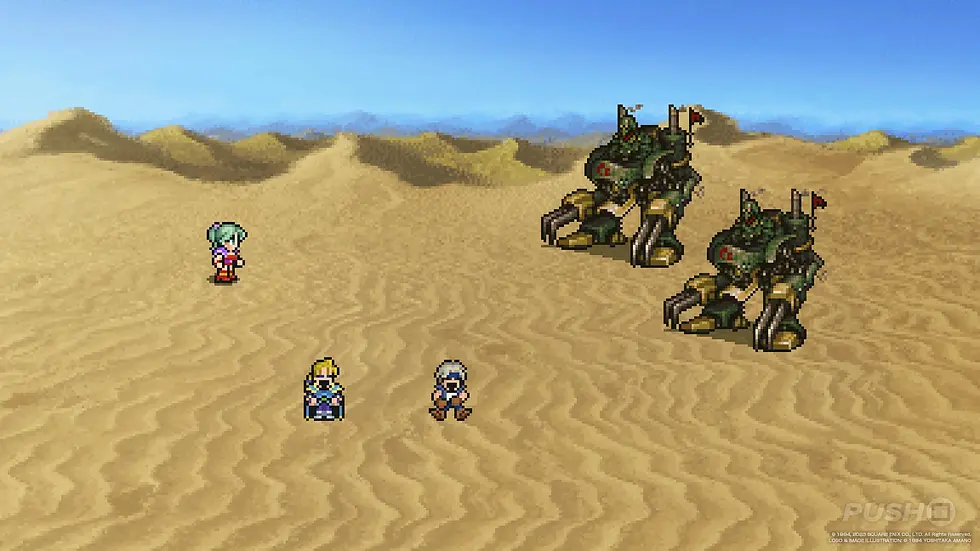
But as I said, most of this is stuff I’ve covered before. There really isn’t much new to cover as far as battles are concerned aside from three things. One is the different formations you can run into. You know how you could get attacked from behind in previous games, well in VI you can also get surrounded by enemies and vice versa.
This changes the battles a little bit. The row system is removed, and instead you’ll take more damage if you’re facing away from an enemy. So you’ll have to make sure characters aren’t just fighting one side otherwise the other one is going to do some damage.
But if you are surrounding the enemy you do more damage when they face away from you, and they always face the last person who hit them. So there’s a balancing act in keeping the attacks up on both sides to either keep the damage up, or defend better depending on the set-up. These battles don’t appear often, but the different strategies they require do help add some variety to the battles.
Second are the Desperation Attacks. Whenever a character is at critical health there’s a chance that they’ll use a super powerful special move. Sounds cool, but you will very rarely see these if you ever see them at all. Throughout my entire playthrough I only saw two of these things. As cool as these things are, they’re such a non-factor that you’re likely to forget they’re even in the game. But this idea of characters having flashy special attacks is something to keep in mind for next time.
But the third, and most prominent aspect that stands out is, you guessed it, the characters unique abilities. Every character has a unique command only they can do in combat. While there are other ways each character can stand out like what kinds of weapons they use or their base stats, it is their unique abilities you really want to focus on. But I think it’s time to start talking about the characters and what they can do.
Edgar can best be described as the games Warrior. He has great defence and attack which makes him a great frontline fighter, and he’s one of only two characters who can wield spears which makes him an ideal Dragoon candidate. Granted becoming a Dragoon replaces the basic attack with the Jump command, but you won’t be using that much with Edgar anyway.
See Edgar’s unique ability are his Tools. Which are special gadgets he can use in combat. He has area of effect attacks like Auto-Crossbow, Bio Blaster and Flash, with the latter two and Noise Blaster also being able to inflict status ailments. But the ones you will be using most are Drill and Chainsaw. Yes, he has a fucking chainsaw, and yes, it does indeed come with a hockey mask. Because why not.
Drill is a great damage dealing option that also pierces defence, while Chainsaw also does good damage and has a chance to insta kill enemies. There are more Tools, but those are the ones I wound up using most. Edgar is best used as a damage dealer, spamming his tools to help clear out groups of enemies. His high defence also makes him a good wall and combined with Knights Code he can help defend the squishier characters. I liked Edgar a lot and he certainly pulled his weight throughout the game.
Then there’s Locke who serves as the games Thief, sorry Treasure Hunter. His unique command is Steal, which is great for keeping items stocked in the early game but becomes a little less useful later on. That is until you get the Thief Bracers and change it to Mug where it becomes one of the more damaging physical moves in the game. In fact, if you combine it with the Master Scroll which lets you hit four times in a row, Locke becomes one of the best physical damage dealers in the game.
Despite being a thief, sorry treasure hunter, Locke has a pretty decent stat spread. He’s not the tankiest character but he can still take a hit, his attack stat is pretty good, and he’s one of the faster characters in the game. Even his magic stats are ok, which is great because magic is very important in this. Locke is just a great all-rounder and he was one of my favourite characters to use in the game.
Now there are a lot of characters in this game, and I will cover them all in good time. I’ll also go over Terra later since her unique trait isn’t available right now. She can cast magic which the others can’t, but that’s not actually a unique trait for her as you will soon see. So I’ll go over her later as well as the other eleven characters in the game.
You read that right. There’s fourteen playable characters in this game, so we have a lot to cover in this. Both good and bad. Suffice to say while having fourteen playable characters does have a lot of benefits, it does also come with a fair few drawbacks.
The next order of business is to get Terra to the Returner Hideout. The only way to get there though is by traveling through Mt Kolts. It would be a smooth climb but there’s a martial artist named Vargas who ends up getting in the way. But help comes in the form of Sabin, Edgar’s twin brother.
Let’s back up a little bit. Sabin and Vargas were both students of a man named Duncan who was also Vargas’ father. In traditional kung-fu movie fashion Vargas was jealous of Sabin since he was chosen as successor, so he killed his dad as revenge and Sabin is out to avenge his master. Which he does, and that’s the end of that. This scene just kind of happens really. It’s brought up and ended so quickly it feels almost pointless.
But the important part is Edgar and Sabin’s reunion. The two are happy to see each other after so many years apart. Sabin left Figaro and his duties to the throne a while ago to live a life of his own, and he’s since become a very powerful martial artist.
Based on that you can probably tell that Sabin is the Monk of the party. He’s all about hitting hard and fast with his powerful Blitz techniques. Which are literally fighting game special moves. I’m not even exaggerating; Sabin’s entire thing is using fighting game moves right down to the inputs. In fact, several of his Blitz techniques are directly inspired by classic fighting game moves. As a fighting game fan I got a kick out of the references.
Also here’s a fun fact, Sabin and Edgar are based on the Bogard brothers from Fatal Fury. Their creator, Kaori Tanaka who also worked as graphic designer for the game, was a huge Fatal Fury fan and included them as a homage to that series. That’s pretty cool, and it does highlight one of the more interesting aspects of the behind the scenes of this game.
The idea the team had when developing the story was that every character could theoretically be the lead. Because there really isn’t a main character in VI. You’d think it would be Terra since she’s who we start with, and also due to her appearance in the Dissidia games, but truthfully the game doesn’t have a central focus. The entire cast is treated like they could be the main character.
Because of that, the characters were designed and written by different members of the development team. Sakaguchi created a few characters, Nomura created some, all of the major developers had a hand in creating the main cast. It really shows how much of a collaborative effort game development is.
But because the characters were written by different people, it does mean the individual character stories can vary a bit in terms of tone. I don’t think it ever gets to the point where it creates any tonal clashes, and it means there’s a wide variety of different stories being told here. So there’s bound to be at least one character whose story connects with you.
But back to Sabin. He’s one of my favourite characters in the game. Being a good mixed attacker that can fill a variety of different roles in the party. I had him double as a healer and he wound up being decent at that.
It’s also worth noting that the Blitz command is a little different in the Pixel Remaster. In the original you had to pick it then input the right commands for the move you wanted. In the Pixel Remaster you pick the command you want to do from a menu and then do the input. It helps make them easier to pull off.
After crossing the mountain, it doesn’t take long for the party to reach the Returner Headquarters. Terra is then introduced to Banon, the boss of the Returners who wants her help in fighting the empire. Terra is hesitant to join due to her not knowing who she is, but none of the others are going to force her to join. She needs to decide that on her own. But after some words of encouragement, she decides to join the fight.
With Terra onboard the Returners try to figure out what to do. It’s obvious the empire is after the Espers to fuel their Magitek and doing so could cause a second War of the Magi. Nobody wants that to happen, but their knowledge on Espers is limited so they can’t exactly come up with much of a counterattack
.
But they do know about the frozen Esper in Narshe and the unique reaction it had with Terra. So they plan on taking Terra back there to see if they can try to extract more information from it. Considering what happened to Biggs and Wedge that doesn’t seem like the best plan, but desperate times and all that.
And times are indeed desperate. Because while these guys were sitting around discussing things like the People’s Front of Judea, the empire just invaded South Figaro and is now heading this way. Locke heads back to try and distract them, while the others take a raft to Narshe. Along the way they run into a crazy looking octopus named Ultros.
They fight Ultros off, but during the kerfuffle Sabin winds up separated from the party and drifts down the wrong river. It’s at this point the story splits into three paths. One following Terra and her group, one following Locke, and one following Sabin. It doesn’t matter what order you do them in, and you have to do them all anyway, so just do them in any order you want.
I’ll cover them in order from shortest to longest. In Terra’s story they make it to Narshe but the guards won’t let them in. They’re still mad at Terra for the whole trying to burn their village down thing. Oh come on guys, it was one time. Get over it. They’re able to sneak into the back and meet Arvis again who takes them to the Narshe elder so they can try to convince him to join the battle against the empire.
That’s pretty much it. Not much really happens in Terra’s story and it only exists to serve as a set-up point for when the three stories converge. Locke’s story is a lot more interesting though. He did his job of distracting the soldiers, but now he’s stuck in town and needs to find a way out. Fortunately his thieving skills, sorry treasure hunting skills let him steal the clothes off of soldiers and merchants to use as a disguise. Like he just strips them nude in one stroke. There’s something I’m not going to think too deeply about.
After a bit of sneaking and stripping, Locke runs into a general for the empire being tortured for treason. This is Celes, a famed member of the empire who has since turned against them due to all the atrocities being committed in their name. Especially a plan currently being committed by Kefka we’ll cover in a bit.

Not wanting to leave a woman in danger, Locke busts her out and she agrees to team up with him since there isn’t anywhere else for her to go. It’s also obvious the two have a thing for each other so that probably encouraged things a bit.
Celes proves her strength in combat when they run into a machine called the Tunnel Armour. Like a lot of the other empire’s mechs it’s able to use powerful magics that can easily kill the party, but Celes’ Runic ability let’s her absorb the magic and convert it to MP. An ability that perfectly complements her playstyle.
Celes is a Magic Knight, meaning she’s both a great frontline fighter and spellcaster. She also has good defensive stats which makes her a fantastic tank. I ended up making her more of a White Mage, but you can also make her an offensive focused character if you prefer. She wound up being the character I used the most, with the only downside being that her Runic ability can also absorb your own spells if you aren’t careful.
This is where Locke’s story ended. So, let’s finish off with Sabin’s story. Which is also the best in my opinion. Sabin washes up on the Doma continent. Nearby at a cabin Sabin manages to wrangle up some help from Shadow. A ninja with a mysterious past who works as a sword for hire. You meet him earlier in a bar in South Figaro, but he didn’t do much other than stand there and act all mysterious. Which is kind of all he does really. I mean it fits the ninja thing he’s got going so I can’t complain.
Shadow is another main party member, but he doesn’t become a permanent member until much, much later on. This is only a temporary job for him, and you don’t even need to recruit him if you don’t want to. He’s entirely optional here.
You will probably want to get him though. It costs a bit, but you should have the money for it, and two hands are always better than one. While he isn’t a permanent cast member yet, I might as well cover how he plays now. No real reason to delay that since he’s very straight forward.
Shadow is a Ninja, and he has all the abilities and traits of past Final Fantasy ninjas. Good speed and attack, but not much in the way of defence. Except his evasion which is very high. If you optimise him right, it is basically impossible for him to get hit. It ironically makes him a great wall despite his defence not being great. Hard to break something you can’t even hit.
He also has the Throw command which remains a great damage dealing option. The only thing Shadow can’t do that past Ninja’s could is dual wield. Since that’s an ability available to everyone with the Genji Glove Relic. Mind you dual wielding isn’t nearly as powerful in this, so it’s not a huge loss I guess.
But I’ll tell you what Shadow has that other ninjas don’t, a little dog that follows him around. Yeah, he has a dog with him named Interceptor, because of course a man named Shadow would name his pet that, and the dog isn’t there for decoration. It will actually help in battle. If Shadow dodges or blocks an attack, there’s a chance that Interceptor will counter with an attack of his own that does a good chunk of damage. Seriously this hound is jacked, and with how high Shadow’s evasion is this will happen more often than you think.
This alone makes Shadow one of my favourite characters in the game. He’s already great on his own thanks to high damage output, speed, and Throw being an excellent command once again, but Interceptor is what puts him over the edge. The fact the dog can block an attack from anything up to and including godlike beings and hit back just as hard is the kind of goofy shit I love about this series.
With Shadow in tow, or not it’s up to you, Sabin winds up wandering into a battle between the empire and the Kingdom of Doma. The empire has been assaulting them for a while, but Doma is a fortress that’s nigh impenetrable.
Not helped by Doma having Cyan, a swordsman of unparalleled ability who also talks in old timey English. Which is odd because he’s supposed to be a samurai, and also because no one else in Doma speaks like that. Not that I’m complaining mind you, I love how Cyan talks in this game. it really helps him stand out and fits his noble personality.
The attack is being led by General Leo who, despite working for a clearly evil organisation, is actually a stand-out guy. He cares for his men and is trying to avoid rushing the attack so as not to cause any unnecessary casualties. Unfortunately, he’s called away for a meeting, and this leaves Kefka in charge. And since Kefka is the kind of guy who just wants to kill em all and let God sort them out, he plans on just poisoning Doma and going home.
This part of the story is interesting. Not just from a character and narrative perspective, but also because of how it highlights the strengths and weaknesses of the writing at the same time. I’ve said in previous parts of this retrospective that Final Fantasy’s writing doesn’t always make that much sense. There’s usually a lot of leaps in logic and plot holes involved in their stories. Some are certainly worse than others in that respect but generally speaking Final Fantasy stories don’t hold up if you think about them too much.
But that’s perfectly fine for the kinds of stories they tell. Final Fantasy isn’t really a series dedicated to more logical stories; it’s more about emotional storytelling. The writing is focused more so on creating a strong emotional response from the player. Not that the writers put no thought into the plotting or anything, but they’re less focused on crafting intricately constructed narratives, and more about telling simpler stories with powerful emotional beats.
It’s very fairy tale like and based on that the writing works incredibly well. The problem is that because the stories are dedicated more to creating those big emotional moments than on the actual plot, it can make some moments a bit nonsensical.
The poisoning of Doma is the perfect example of this. Because from an emotional perspective it’s devastating. Cyan is left as the only survivor, well him and some other guy but he never comes back so you can just ignore him, and he has to watch as his king, his friends, and even his wife and son die around him.
You can really feel the despair Cyan is feeling, and when he goes in a rage and starts attacking the empire soldiers you completely empathise with the guy. This should be a powerful moment, but there’s one thing holding it back. That being that it makes absolutely no fucking sense.
The logistics of how the poisoning works just do not add up. Everyone dies from it so quickly that it strains credulity. The only way it can happen as presented is if everyone in the kingdom drank the water at the same time. Which is ridiculous for several reasons, not the least of which being that these people must of all had to drink directly from the river instead of gathering a small supply for personal use. You know the thing people do in the real world.
The game does imply that simply being near the poison is enough, but that just raises further questions. In fact the game flip flops on how the poison even works. First they say you need to drink it, then they say simply touching it is fatal, and in the end it’s implied that just being near it is enough to kill people. Like does it make a toxic cloud or something because if that’s the case then why did Kefka poison the water supply. And how does that create the toxic miasma? Did it evaporate or something.
The more you think about it the stupider it gets. For what is supposed to be a big emotional gut punch it doesn’t get the required response because all you can think about is how much it doesn’t add up. If you think about this scene for a microsecond it falls like a poorly played game of Jenga.
This is Final Fantasy VI in a nutshell. You really can’t think about the story too deeply otherwise you notice all the little ways it doesn’t make sense and believe me they will pile up. However, that doesn’t mean I think the story is brainless. The story does have a strong central theme that it tries to tackle and emotionally speaking it does resonate very strongly.
The key to enjoying the story is to give in to the emotions it tries to create. Don’t think about the logistics of the plot but let the feelings of the scene dictate everything. Some of you may not enjoy that. I know there are plenty of people who prefer stories that are more logically constructed and those people definitely won’t get as into this. For me I enjoyed the story enough that the dumber moments didn’t ruin anything, but they did make me raise an eyebrow at them.
So Cyan is super angry right now, but Sabin is able to get him to calm down enough that they can team up to escape the camp. Helps that they have a common enemy. Cyan then becomes the next party member, but sadly he’s one of the weaker characters in the game.
He has good attack and defence, but he’s pretty slow and he’s not that good with magic. That might not seem that bad since he’s clearly built more for physical attacks, but magic is really important in this game and not being that good at it is a big detriment.
His unique command Bushido can have its uses with different moves, but they have a charge time to them and it takes a while for the more powerful moves to activate. Although credit where it’s due, the Pixel Remaster does make it much better since you can just pick the move you want and keep fighting with the other characters. You don’t need to wait for a meter to build up like in the original. It makes Cyan a much better character, but still not a great one.
After escaping the camp, Sabin’s group are forced to make their way through the Phantom Forest on the Phantom Train. I’ll give you two guesses what the deal with this place is and the first one doesn’t count. Yup, it’s a ghost train and this part is pretty fun. It’s a nice little action sequence where you need to fight your way off the train while dealing with the various spooks and spectres.
The best part is at the end though. Because the only way off the Phantom Train is to fight the Phantom Train. You have to fight the fucking ghost train head on, awesome! If you thought that wasn’t cool enough, get a load of this shit.
Fucking incredible! Sabin power bombing the Phantom Train is one of the most memorable parts of this game. I don’t think I need to explain why just look at it. It’s so glorious in it’s absurd badassery that it goes from being ridiculously stupid to one of the coolest things I’ve ever seen, and it was a glitch.
Yeah, this wasn’t supposed to be in the game. It was a programming bug, but it became so iconic they kept it in all subsequent versions. In fact there was some controversy in the original Pixel Remaster release on Steam since they took it out. People were so mad they ended up having to patch it back in. The only other instance I’ve seen of a glitch being patched back into a game is the Juggernaut glitch from MVC2 in the Marvel vs Capcom Fighting Collection. People love it that much. There’s a trading card based on it for Christ’s sake. This is legendary.
There’s a sweet moment afterwards of Cyan seeing his family board the train for the afterlife. Despite their deaths not making the most sense this is a very good moment. I did tear up a bit at it. Or I could have been coming down from the high of the train suplex. Who can say.
After this Sabin and company arrive at Baren Falls where Shadow decides to leave. I guess he figured fighting a spectre train was enough excitement for one day. Can’t say I blame him. Then Sabin and Cyan decide to just jump from the falls. I would like to remind everyone that these two are just trying to get to Narshe. How is any of this is supposed to get them there.
After plummeting from a giant waterfall, they somehow survive and wind up on the Veldt. A wild area where all the worlds’ monsters gather. It’s here where they’re found by a feral wild child named Gau. Who unfortunately showcases two major issues with the games structure both narratively and gameplay wise.
I said earlier that the idea going into Final Fantasy VI was that every character could be the lead. Everyone would have their own storyline and be given as much narrative importance as anyone else. In theory this is a cool idea, and as modern games like Octopath Traveler have shown it can work very well. Even one of Final Fantasy VI’s contemporaries Live a Live showed there’s a lot of merit to that idea.
In practice though, I don’t think this game fully delivers on the idea. There are characters that feel more important to the overall story than others. Now, I expect this to happen. Games with large casts like this are obviously not going to give every character equal narrative weight. That’s an unrealistic expectation.
However, the conceit behind the story was that any of the playable cast could be viewed as a main character. Not necessarily of the main plot but of their own story. But even when viewed in that way, I don’t think they fully succeeded. Mainly because some character stories just aren’t that interesting on their own.
Terra, Celes and Locke have very interesting stories. Those are the characters that were most compelling to me. Cyan’s story is a decent revenge tale, but nothing spectacular. Shadow is cool, but his story is a lot more mysterious and kept in the background. And Edgar and Sabin are likable, but don’t really have much of a story arc. Some characters are just more compelling than others which makes them feel more important.
Gau is a prime example of this. Gau is the comic relief character. He’s just a goofy wild child, and that’s pretty much it. He doesn’t have any major character development or any big emotional moments; he’s just a caveman. I don’t even think he’s that funny, so he doesn’t even work that well as a comic relief. At least for me. Humour is subjective so your mileage may vary with him.
Now that’s not to stay Gau doesn’t have a backstory, it’s just that it isn’t much of one. His mom died giving birth to him and his dad went mad and abandoned him in the wilds to die. That’s it. The dad doesn’t become a major player in the story, in fact Gau’s big story moment is so unimportant that you can ignore it and not miss anything.
As a character he’s just not all that engaging. Gameplay wise though he is pretty fun. The idea with Gau is he’s sort of a mix between a Blue Mage and a Berserker. Which is a little awkward since there are already two characters that fit those roles in this game, but Gau is still unique. How it works is that Gau has Rages where he takes on the properties of the different enemies in the game.
So if you choose something like the Lesser Lopros then he’ll fight like that enemy did. Not just by using their attacks but also their unique properties like being able to float or even being undead. Given how many enemies there are, Gau is given plenty of options to choose from. Which is actually more of a problem for him.
Gau simply has too many Rages to pick from. You’re never going to remember them all, so inevitably you’re just going to find the ones that work best and use them over and over again. It can make the other options feel like bloat, and having to wade through the entire list of Rages just to get to the one you want is tedious. This is why I keep battles on Wait, if it was on Active I would be taking too many pot-shots simply for navigating the menus.
That’s on top of Rages being a pain in the ass to get. See Gau can only get Rages while he is on the Veldt. Gau has a unique Leap command that you can only use there and when he does, he will leap at the enemy and end the fight prematurely. Then he comes back after a few battles, and he will then have the Rages of the enemies he leapt at and the ones you defeated when he returns.
Now that doesn’t sound too bad, but with the random encounters in this game it can take ages to get the Rages you want. Even if you aren’t hunting for a specific one it can still take a few hours to get them all, and you will want to try to get as many as you can on a first playthrough. You don’t know what they all do so you’ll want to experiment with as many as you can. Unless you use a walkthrough, which is honestly the best thing to do with him. It will save you so much tedium.
Now I will give the game credit that it does give Gau a handful of Rages to start off with. Which is an addition of the Pixel Remaster. This makes it a lot easier to get started with him. It’s still tedious to get everything for Gau, but at least it actually gives him something to start with. So you don’t have to spend too much time grinding for Rages at the start.
The kicker with all this is that Gau is really good. Some of his Rages can make him an absolute powerhouse. The lack of control you have when he’s transformed sucks, but he usually does what you want, and it is satisfying watching him go to town on the enemy. It’s just that getting to that point is not fun.
This is the second problem Gau highlights, the character balance. I’m not talking about how some characters are stronger than others. That’s normal in a game like this. No what I’m talking about is the effort required for them.
To properly explain this let me talk about fighting games for a beat. I know this is a bit of a non-sequitur but trust me I’m going somewhere with this. See in fighting games there’s this thing called high execution. Which to put it in the simplest way possible are characters that are hard to play. They might have a more complex strategy or tight combo structure or may just have a gameplay style that’s more unorthodox, but they’re all generally characters that aren’t the easiest to just pick up and play.
Now this doesn’t mean those characters are bad. If you look at a couple of fighting game tier-lists, it’s not too uncommon to find characters with high execution sitting near or at the top of the list. Vega from Street Fighter II is hard to play but he’s regularly considered one of the best characters in that game. One of the more popular examples is Magneto from Marvel vs Capcom 2. He’s one of the three gods of that game and he’s got a notoriously high execution barrier.
So having high execution doesn’t inherently mean the character is bad, but it is still a detriment. Because at the end of the day it still means the character requires more of an effort to play, and in a competitive game where you want to get the best results with the least effort that’s not ideal. It’s why you don’t see many of these high execution characters in tournaments. Aside from older games, but that’s because those player bases have been playing them for years and have optimised the shit out of them.
Final Fantasy VI has a similar issue. There are characters that are very strong but require more effort than other members of the cast. Gau is a very strong character, but to make him strong you need his Rages which requires you to grind on the Veldt to get the ones you want. If you’re lucky you can get the stronger ones early, but more likely you’ll be spending a few hours searching for them.
Why do that when you can just level up the other characters. You can get similar results from them for far less effort. Gau’s Rages give him powerful area of effect spells, but I would much rather use Terra and Celes for that because, while they are more limited due to needing MP, their damage output is similar and getting those abilities is much easier for them.
Gau is not alone in this, but he is the worst example of it. Honestly, I didn’t spend too much time with him. I still tried to get him some of the better Rages because, spoilers, you still need him for the end game, but he was not my first pick in most situations. Or my fifth for that matter.
But Gau is on the team regardless of what you think of him. Or he is after you feed him some meat because, well he’s basically an animal and food is always the best way to get those to like you. To say thanks, he takes Sabin and Cyan back to his cave to show them his shiny treasure, a diving helmet. Which they can then use to ride an underwater current called the Serpent Trench. How all three of them are going to do this with one helmet I have no idea.
So they ride the trench to the town of Nikeah, and they hire a ship there to take them to Narshe. That was a long-winded way of getting them there. I mean there was a ghost train, they fell down a waterfall, went through an underwater trench, and visited a town just to hire a ship. Can you see why I saved it for last; a lot happens in it.
But now that everyone is in Narshe the story can finally continue. Banon tries to convince the Narshe Elder to join them, but he doesn’t want to. See Narshe is like Sweden in this situation, they want to remain neutral so that no one will invade them. Even though the Empire just invaded them not that long ago. Yeah, they’re just a pack of cowards.
There’s also some drama between Celes and Cyan since she’s a former empire general and he’s not their biggest fan right now. It’s a small moment, but I do like that there is some friction between the cast. It helps make them feel like individuals with their own backgrounds rather than one big friend group.
But enough character bonding, the empire is invading. Remind me again why you’re remaining neutral Narshe? You fucking dumbasses. This is another defence mission where you need to make three separate parties. This one is more fun though because you have more characters to play around with. It’s also the last, which is a little disappointing considering how fun they are. There are still moments with multiple parties, but not like this.
It makes me wonder if more of these battles were planned but never implemented. It does seem weird to have one in the games opening and then only using it one other time. This game did have a lot of cut content, probably due to the tight development time, so it wouldn’t surprise me if that was the case.
With their powers combined the party is able to repel the attack, so it’s time to talk to that Esper. Which goes horribly wrong much to no one’s shock. The Esper has another strange reaction to Terra, but this time Terra has her own reaction. Becoming a pink energy creature? A monster? I’m not sure but it’s some kind of anime transformation, and she flies off.
Confused on what is going on, the gang decides to head out to find her. But only four members go, the other two stay behind to guard Narshe in case the empire comes back. You don’t need to take four, you can take three if you want since you can recruit Shadow again, but it’s easier if you just take four since Shadow doesn’t stick around.
You can take whoever you want, but I went with Locke, Celes, Edgar and Sabin. Not just because I like them more, but also because you get a bit more story with this set-up. Terra was seen flying west, and the only way to reach the western continent is to dig there with Figaro castle, and if you bring Edgar and Sabin there you get a scene that goes over their backstories.
Their dad died years previous and Sabin, being the more emotional and hot-headed of the two, took it the hardest. Despite their father leaving his kingdom to them, Sabin didn’t want the responsibility. He wanted to live on his own terms, and he wasn’t keen on the formality of palace life. So one night he asked Edgar to leave with him, and the two made a deal. They would flip a coin and depending on how it landed, one of them would be allowed to choose the life they wanted.
Sabin won, hence why he became a martial artist. It’s revealed in a later scene that the coin was one-sided, and Edgar intentionally gave up his freedom for the sake of his brother. It’s a good scene that shows how deeply these two care for each other despite their differences. And it’s entirely optional.
You can miss this scene unless you have Edgar and Sabin in your team when you visit Figaro. It doesn’t have to be now, I think you can do this whenever you visit it, but this is one of the only times you need to revisit Figaro. So it’s the time you are most likely to get this scene.
I already mentioned this in the last part but it’s worth reiterating, I don’t like when story moments are optional. I can understand it for things like lore that isn’t integral to the plot, but character related moments like this should be part of the main narrative. This is the kind of thing that fleshes them out and makes the cast more interesting, it’s very important this be something you see. Don’t make it skippable.

Another scene similar to this involves Locke. While on Terra’s trail the party visit the town of Kohlingen. This is Locke’s hometown, and it is here we get his backstory. He had a girlfriend named Rachel who went with him on his treasure hunts. But one day there was an accident and she got amnesia. Locke tried to help but decided it was best to leave her alone to start her life over since his presence was causing her distress. Then a few years later she died in an imperial attack, right when she got her memory of him back. It’s like twisting the knife after rubbing salt in the wound.
Rachel isn’t fully dead though, only mostly dead. Locke has been able to keep her body in a sort of suspended animation thanks to a very creepy herbalist. Ok, it’s not as bad as it sounds. He’s doing this because there’s a legendary treasure that can bring back the souls of the dead, and he wants to keep Rachel’s body pristine so he can resurrect her. It’s a Mr Freeze type situation.
This is also why he’s so protective of Terra and Celes. He feels guilty over not being there to protect Rachel and doesn’t want it to happen again. I like Locke’s backstory. It makes him an easy guy to empathise with, and it adds a new layer to his relationship with Celes. It’s very obvious the two have feelings for each other, but Locke is still hung up on Rachel so how far can they really take this. It makes everything a lot more awkward when there’s a third woman in the mix, especially when they’re dead. You ever see Rebecca.
I can understand having these scenes be optional to an extent. Given the focus on having a larger cast of characters and being able to make your own teams, it would be much harder if not impossible to make all of these scenes mandatory. Not unless you wanted to restrict what characters the players could use. Which they do on occasion here, but that isn’t something you want to do a lot. It can end up feeling too restrictive.
So I get these scenes are optional as a byproduct of the games design. It’s simply unavoidable with this set-up. I can’t be that critical of it in that regard, but this kind of thing still bugs me. I hate missing important story beats in games, and I just can’t get over that.
But back to the main plot. The group manages to trace Terra to the town of Zozo. This is a town made up of the outcasts of the town of Jidoor. A posh place full of rich snobs that exiled all of the poor people. So one is a rich haven while the other is a dump filled with liars, cutthroats and every low life you can imagine. It’s worse than Detroit.
They find Terra in the highest building but she’s in a weird feral state. It’s a little funny watching her lie there growling while occasionally leaping around like an animal. I don’t think it’s meant to be funny, but it was. They also meet Ramuh, a human looking Esper who has been taking care of Terra. He then explains a bit more about the War of the Magi.
See it used to be that Espers and humans lived together in harmony, but then people found a way to forcibly extract magic from Espers to gain their powers. This caused the war between the two factions, and when it was over the Espers all fled to another world to avoid this happening again. Then about twenty years ago the empire found the Esper world, kidnapped a bunch of them, and are trying to extract their magic. This is what fuels Magitek.
Ramuh escaped from the facility where this is happening and asks the party to head there and rescue the other Espers. Both because he feels guilty about leaving them behind, and also because doing so will help Terra. Because you see, Terra is an Esper herself. Well kind of, it’s a little bit more complicated.
But she possesses an Espers power, that’s the important part. This is why she the frozen Esper had the weird reaction it did and explains the transformation. But because Terra has no memories to understand what is going on, she can’t control her Esper form. But there’s a way that might be able to help her regain her sense of self.
See there’s another way Espers can provide magic to humans that’s a lot purer than sucking it out of them. Whenever Espers die their bodies become a magic crystal called Magicite. Which, if wielded by a human, bestows them the mystical powers of the Esper. Ramuh then turns himself into Magicite and gives us the Magicite of other Espers that escaped with him.
Which brings us to the Magicite system. Here’s how it works, every character can equip one piece of Magicite which is tied to one of the Espers. While equipped you can use the Magicite to summon that Esper once per battle. This is how summoning works in this game, and no I’m not covering all the summons because there are way too many of them and this review is long enough as is.
I will mention two though. The first is Cait Sith who is the one of the first you get in this game. He’s not that important right now, but he will be in the next game. The second is Alexander. A giant robot shaped like a castle that would become a series staple. I really like Alexander; he’s basically a giant fantasy mecha. How can you not love him.
But summoning is only a part of how Magicite works. It’s really more of a bonus than anything else. What you really want to use Magicite for is the magic attached to it. Every piece of Magicite has magic spells associated with it, and while it’s equipped that character can use AP gained from battles to learn those spells.
But what this essentially means is that any character can learn any spell. They aren’t locked to specific classes or characters, if you want everyone to know healing magic you can totally do that. Now not everyone is going to be the most efficient at casting magic, but you don’t have to give them Magicite for that.
Magicite can also increase certain stats if it’s equipped when a character levels up. So if you level up with Ramuh you gain a +1 in stamina for example. So you can completely ignore the magic part of this for some characters and focus entirely on the stat growth. Not every Magicite increases stats, but the ones that don’t have more magic spells to learn so it evens out.
Regardless, you will likely have characters that share spells between them. Especially since the spells are shared between different pieces of Magicite. Though the rate of learning them varies from each piece. Multiple pieces can learn Thunder magic, but Ramuh learns it faster for example. So there’s bound to be a lot of overlap between characters in terms of magic.
This does give you a great amount of customisation, and if you know me by now you know I love strong customisation in my RPG’s. However, I’m kind of torn on the Magicite system. I like the customisation it offers, but it can also make characters feel a bit homogonous. When every character has more or less the same spells it can make a lot of them feel the same outside their unique abilities.
Mind you that is a major advantage to this system. If there’s a character whose ability you don’t like, just make them a mage. I’ve seen people online say they do that for Gau because they can’t get used to how he works. Sure, they won’t stand out that much considering every other character has magic, but at least they will have some use, and it helps to have multiple spell users in the game since you will be swapping parties a few times in this.
It’s best to have at least three dedicated Black and White Mages in this. Or at least have multiple characters with the healing and elemental spells because magic is really damn good in this game. Elemental spells are really useful at dealing with enemy weaknesses, and the higher-level spells are great at crowd control. Healing magic is also a must since healing items honestly kind of suck in this, and dungeons can get pretty lengthy. You’ll want a few characters with Cure in the party to keep everyone healthy.
It makes sense for it to be designed this way with how many characters there are, but it can be a little messy. It can be hard to keep track of who knows what spell due to how many there are. Plus, while it is useful for characters whose abilities aren’t great, that still means that they’ll have a command you never use. And if you have a character who just uses Magicite for the stat buffs they’ll still wind up with spells they never cast.
Basically, no matter what there’s going to be some bloat. Granted it’s not like having all this is bad, it is better to be overprepared than underprepared after all, but I like my games to have a more streamlined design. I would rather have a few options I always use than dozens of options I never consider. It’s just how I am.
I wouldn’t call the Magicite system bad, just messy. It still allows for a lot of customisations and for some they like how messy and bloated it is. Having an entire team with this many abilities is really fun and I can see why. But for me I greatly preferred how the Job System handled this. It was simpler, cleaner, and allowed character roles to be a bit more defined.
But now that we have some Magicite it’s time to hit that Magitek facility. The rest of the party manages to make their way to Zozo and regroup. Celes decides to lead the charge into the facility. The Research Facility was where she was first given her magical powers, so she knows the area better than anyone. Locke decides to go too in order to watch over her.
The other two slots are up to you. I personally kept Edgar but swapped Sabin with Cyan to shake things up. I would recommend you do this too since you will need to use everyone at some point so it’s best to get used to how everyone plays. You don’t need to worry about levels though. The game auto levels characters who haven’t been in the party for a while. Except for Gau, he didn’t do that and I don’t know why. It’s like he’s going out of his way to piss me off.
While the party has a destination, they now have a problem in how they’re going to get there. The Magitek Facility is near the empire’s homeland, and they have no way of reaching it. But help comes in the form of a kidnapping plot. Back in Jidoor they find out that an Impresario for the local opera house is having a crisis. Their main diva has caught the attention of the wandering gambler Setzer who wants her for his bride.
Celes as it turns out is the spitting image of that diva, and Setzer just so happens to have the only airship in the world. I think you can see where this is going. It’s the old switcheroo plot, have Celes impersonate the Diva, have her get kidnapped, take Setzer’s airship, sail to the Magitek Facility, get the Magicite, and save Terra.
Which brings us to the opera scene. Chances are if you know anything about Final Fantasy VI it’s this specific scene. For good reason, it’s one of the most memorable moments in the game, the series, and even gaming as a whole.
The opera itself is a mini story about a soldier named Draco and a Princess named Maria who are in love but are torn apart by war. Like any good story within a story there’s clear parallels between it and the main plot. Celes’ song has some clear allusions to her relationship with Locke. It’s subtle enough to not be too obvious, but it’s not too hard to read between the lines.
It’s a very emotional song. About lost love and learning to let go. A lot of people say they cry at this scene, and while I’m not one of them it is easy to see why people would get misty eyed at it. A lot of that is down to the music, and now I can finally talk about the presentation.

First let’s talk about the visuals because this game looks damned good. You can tell by this point that Square Enix had a firm grasp of the Super Nintendo’s architecture because this is easily the best-looking Final Fantasy on the console. Hell, forget best looking Final Fantasy, it’s one of the best-looking games on the console period.
It’s got some of the best sprite work of the 16-bit era. The backgrounds and enemy battle sprites are some of the most richly detailed I’ve ever seen. I have to call out the enemy sprites in particular. They aren’t as gnarly as the ones in V but a lot of the enemies in VI are still impressive just in how big they are. The scale of the endgame bosses can be awe inspiring.
There’s also a lot of great visual effects. The magic looks the best it ever has, and the usage of the SNES Mode 7 feature is far more impressive looking than the attempts in past games. Not that it looked bad there, but those felt like prototypes compared to this.
Final Fantasy V was an improvement on IV visually, but VI feels like it’s lightyears ahead. One major improvement is in the character sprites. In previous Final Fantasy games, they would have different sprites for the characters for when they were in battle and when they were in the overworld. The battle sprites being larger and more detailed while the overworld sprites were tiny and more simplistic. A decision largely made because of technical limitations.
But in VI there is no difference. The sprites used for battle are the same ones used in the overworld. This not only makes the overworld look more visually impressive just for having larger characters, but also allows for far more expressive character animations with more unique poses that give the characters far more personality.
It also makes the cutscenes a lot more visually interesting. V already showed big improvements at that, and VI only further improves things. It’s part of why the opera scene is so memorable, even if the characters look like cardboard cutouts while dancing.
The Pixel Remaster does have a few graphical changes compared to the original. Namely in the colour palette. The remaster looks a bit brighter, and the character sprites have been given a colour scheme to make them better resemble their original concept art. This does remove some of the original atmosphere, but I don’t mind it personally.
Then there’s the music. Straight up, it’s one of the best soundtracks of all time. I have to confess that I’m not that good at talking about music. Which should be obvious if you read any of my reviews. I don’t know much about music and can’t tell you why a song works or why it doesn’t. I just like what I like. But I will attempt to explain why I like the music so much here.
For me it came down to three things. One is the variety. There’s a lot of different types of songs in this with varying tones and styles that helps make each moment feel distinct. The character themes in particular are very different from one another and reflect each character’s unique personality very well. It’s an eclectic mix of songs that fit each situation perfectly.
Second is the catchiness. I’m going to be humming these songs for weeks if not months. Partly because it all sounds really nice, which should really go without saying, but also because each song fits its situation perfectly. The battle theme is bombastic and exciting, the overworld theme (the first one) is adventurous but also melancholic which fits the tone of the story, and the opera scene is sombre and heart breaking. It’s a beautiful soundtrack.
Which leads me to the third reason, how emotional it is. I don’t like to use the word emotional as a way to describe music because I feel like that’s what music should be at a base level. All forms of art try to make us feel something, but music is the most primal and emotion driven of all art forms. A great drawing might not make you feel anything, but a great song will always make you feel something.
So I feel like praising music for being emotional is like praising water for being wet. It’s what I expect it to be. But I can’t think of anything else to call the music other than emotional. This soundtrack really does go for the heartstrings and plays them like a sweet viola, and it absolutely succeeds at that. This is a very emotion driven story as I said, and one way those stories can work so well is to have a great soundtrack behind them.
This OST is a masterpiece. Combine that with the fantastic visuals, and you have a presentation that is almost untouchable. The only other 16-bit RPG that can potentially match it is Chrono Trigger, and even then, there are clear ways Final Fantasy VI is superior.
This excellent presentation is highlighted perfectly in the opera scene. I mean it’s basically one long cutscene, with some minor gameplay thrown in. So the excellent visuals and music take centre stage. This is also a moment that the Pixel Remaster improves things in a big way.
For one it’s fully orchestrated. Even if you’re using the original music the opera will still use a full orchestra replete with actual vocals. Yes, the Pixel Remaster has actual singing during the opera, and it sounds great. The singers did a great job here. Plus, it uses some 3D backgrounds to make it have a more cinematic feel. Makes me wish they did a full HD2D remake of it.
They clearly knew how important this scene was and went all out in trying to make it look and sound better than ever. I’m sure some will nitpick it and say the original is better, but I think they did a great job here. It was a beautiful and emotional scene on the SNES, and it remains that way in the modern conversions.
But you know what the funny thing about this scene is, for a big emotional moment that makes some players tear up, it’s also very funny. See while the opera is going on, Locke finds out Ultros, is planning to drop an anvil on stage after Celes didn’t read his love letter. It wasn’t actually for her, but he doesn’t know about the switch.
So the gang heads into the rafters to stop him, only to fall down to the stage which forces them to improvise to make it seem like this is all part of the play. They beat Ultros up, he runs off like a bitch, and then Setzer arrives and takes Celes. Really for all the talk fans give on how this scene is a big emotional moment, it’s really just a fun action sequence at its core.
Which makes this opera scene a perfect microcosm of Final Fantasy as a whole. When you break Final Fantasy down then you see that they’re basically just fun adventure stories with powerful emotional beats. This is why the opera scene is so beloved. It represents everything that fans love about the series.
But we must now leave the opera, because now that Setzer is here we can make it to the facility. After we scam Setzer out of a ride with a rigged coin toss. Something he isn’t mad about since he’s a gambler by trade and he’s impressed by the swindle. I like Setzer, he seems like a chill guy if you ignore the attempted kidnapping. That never gets brought up again by the way. Bro tried to steal a woman and received no repercussions. That didn’t age well.
We can’t control the airship just yet, Setzer just takes to where we need to go. Setser also stays behind to watch the ship. Which is a shame because this would have been a good chance to introduce him as a playable character, but I’ll have to save that for later. Now it’s time to head into the Magitek Research Facility.
It’s here where I want to talk about the dungeon design. If I’m being honest, past Final Fantasy games haven’t had the best dungeon designs. Not bad for the standards of the time, but a bit simple by today’s standards. VI’s dungeons on the other hand feel a lot more modern. They have more interesting layouts and have some actual puzzle solving that make them a lot more engaging.
The Magitek Research Facility isn’t the best dungeon, but it still has some interesting stuff in it. There are a lot of side rooms with hidden treasure, there’s some conveyer belts to move around on. It’s nothing too intricate, but it is a fun dungeon.
My only issue with it is that some rooms are massive and it can be a pain to backtrack to get to a room you missed, which is a problem with most of the dungeons to be fair. A lot of the rooms are a little too big. I’m just grateful the random encounter rate is a lot more manageable. If it was like the previous games these dungeons would be a lot more annoying.
Making their way through the facility, the party finds Kefka draining the magic from two Espers. He then says something about awakening the Warring Triad. What’s that? Well that doesn’t come in until later. For now it’s just really blunt foreshadowing.
The party follows after the two Espers, who are the classic duo of Ifrit and Shiva. They also find the basement is littered with the skeletons of a bunch of drained Espers. Showing off just how dangerous the empire’s experiments really are for the poor Espers. Ifrit and Shiva are too far gone to save, but they still lend us their power to fight back against the empire.
The party eventually makes their way to the centre of the research facility. Where they meet the head scientist for the empire, Cid. Who in this game dresses like a banana coloured member of the KKK. This is one of the rare instances where Cid isn’t connected to airships in anyway, and also a rare instance of him being a villain.
Well sort of. He may work for the empire, but he isn’t that bad a guy. He raised Celes as a father figure, and despite the horrific experiments he is committing he isn’t actually aware of the effects they’re having on the Espers. I don’t know how he isn’t aware of that considering he’s the chief scientist who invented the fucking process, but whatever.
When talking to Cid he mentions a rumour to Celes about her being a secret spy for the empire. Kefka even arrives to corroborate this, calling Celes out and ordering her to execute the Returners to show her loyalty. This is obviously complete bullshit, but for some baffling reason everyone else buys into it. Even Locke despite it making absolutely no fucking sense to do so.
Think back to how Celes joined the Returners. Locke found her locked up in a random town, and she joined up because he saved her. So, if she really was a spy this whole time, that means the empires plan was to keep Celes locked up in the basement of a random house and then… hope someone stumbled on her? That’s the dumbest plan I’ve ever heard. No one would buy this was all a secret psyop. One second of thought is enough to destroy it.
This is such bullshit. It’s just there to add friction to Celes and Locke’s relationship, but it doesn’t feel earned. It’s so forced you’d think a Jedi wrote it. Celes tries to prove her real allegiances by teleporting her and Kefka away. Why didn’t she just use it on Kefka? She didn’t need to use it on herself.
This also causes the facility to overload and gives us a bunch of new Magicite. Cid helps us escape and realising the harm his actions have done is now going to convince the emperor to end the war. Because that always works. I would personally pull a Thadeus and shank his ass but that’s just me.
Setzer then arrives with the airship, but Kefka comes back and uses some cranes to try to halt the escape. This is the real reason why Celes teleported away, because this battle exists so it can introduce Setzer as a playable party member. I mean it’s still dumb, but at least there’s some reasoning behind it.
As a gambler by trade Setzer’s unique command is a slot machine with a wide range of effects depending on what you get with it. Some good, some bad. There are a few different effects, but I didn’t get to see most of them since I never got used to how it worked. I can’t tell if it’s random or if you can time it right. I think it’s the latter because speed-runners use this a lot, but if it is I couldn’t get the timing down.
I don’t like this ability. Fortunately, you don’t have to use it. There’s a special Relic Setzer can use that changes his Slot command to Gil Toss. It’s not as interesting and it eats away at your money, but it does a lot of damage and is good for crowd control. So it is a good alternative option if you want something more consistent.
Setzer is a decent enough character without his ability though. He’s one of the few fighters who can attack from the back row, and his weapons all have the chance to do random effects on the enemy. He’s all about luck as you can tell. He’s also got great defence, and his other stats aren’t too bad aside from magic. He’s not a bad character, but not one I used very often. I like the other characters a bit more.
After escaping, Setzer takes us back to Zozo where the Magicite we got is able to help Terra come out of her Esper state. One of the Magicite pieces is even revealed to belong to her dad. This is where we get Terra’s backstory. Terra’s mother once stumbled upon the Esper world after becoming disillusioned with humanity. She then fell in love with an Esper named Maduin and they had Terra.
But not long after this the empire invaded, the Espers were forced to excise all humans, and in the kerfuffle, Terra and her parents were sent to the human world where Terra was stolen by the emperor after killing her parents. With that Terra finally knows who she is. She is the proof that Espers and Humans can indeed live together. Knowing that, she’s able to gain control of her abilities and reach her full potential.
Now I can finally talk about how Terra plays. To be honest though there isn’t much to talk about since she plays identically to Celes. She’s a magic knight with decent attack, defence and magic just like Celes, and even there starting spells are identical. The only difference being Terra starts with Fire while Celes starts with Ice. So basically, Terra and Celes are the Ryu and Ken of this game.

The big difference though is in their abilities. Terra’s unique ability is Trance. You know that Esper form she was in? Now she can transform into that at will. All she needs is to build up some AP between battles and she can transform. With her being able to stay transformed so long as her green meter remains full.
While in this state Terra gets a massive boost in power. Making her physical and magical abilities far stronger. Trance isn’t that useful for normal encounters, but it can shred through bosses. Because of this I focused more on offence with Terra while Celes I made more defensive. Or to be more specific, Terra was the Black Mage while Celes was the White Mage. You don’t have to do it that way, but it’s the way that made the most sense to me.
Terra is one of the better characters in the game. Between her and Celes I would say she is the stronger of the two since Trance is more useful. I still like Celes a lot, and honestly I like her as a character more, but combat wise Terra is better. At least in my opinion.
Now that they have Terra, the party heads back to Narshe to come up with an attack plan. They decide the best course of action is to open the gate to the Esper world. The idea being that the Espers will then attack the empire capitol of Vector, which will open them up for a direct assault for the Returners. Terra being part Esper means she should be capable of doing that.
But before we do that, there’s another party member you can get in Narshe. There’s a thief named Lone Wolf raiding a store house in town. You can chase him into the mines, and when he’s cornered, he takes a Moogle hostage, but it breaks free and you’re able to rescue it. Turns out though the Moogle can actually talk.
This is Mog, Mog the Moogle, and grateful for the rescue he decides to join the team. This is all technically a side quest. Mog is an entirely optional character, so he doesn’t have much of a story. He’s just the cute animal mascot character, and in that regard he’s fine. He adds a fun energy to the roster.
Despite technically being optional I would argue Mog shouldn’t be. Both because of the endgame needing basically a full party, and because he’s frigging awesome. First off, bro is a tank. He has one of the highest defence stats and access to some of the strongest armour in the game. Hell, if you put Mog in the back row with the right set up, he is borderline unkillable.
Then there’s his unique ability, the power of dance. Mog is sort of a mix between the Dancer and Geomancer classes. He has a few different dances based on the different environments in the game. When he does a dance, it will change to that environment, and he’ll perform different attacks and skills based on it.
All you have to do is battle on that environment with Mog and he’ll learn the dance. It’s not too hard to learn them, except for the water dance since you have to make a long way trip which is a little annoying. It’s worth the effort though because it’s one of the better dances Mog has.
Every dance is great though. They have area of effect attacks, and some will even heal the entire party. They don’t cost any MP, and as long as Mog stays alive, he’ll keep the dance going. The one downside is that the dances are random. You can’t control what effects the dances will do, and Mog is a bit clumsy and will sometimes stumble before he even gets a dance going. So it’s useful, but not all that consistent.
Even without that though Mog is still great. He has a decent magic stat, and when combined with his tanky nature he can be an effective healer. He’s also the only other character capable of wielding spears which also means he can be a great physical attacker too. Mog can fit a bunch of different roles outside of his dances, he’s quite the versatile little Moogle.
For the first playable Moogle in the series, Mog is great. In fact, for every future Final Fantasy game where Moogles play a more important role, they would always name the main one Mog. So we’ll be seeing a few Mogs as this series progresses.
It’s at this point where you gain access to the airship, the Blackjack. A massive flying casino that unfortunately doesn’t have any casino minigames. That’s a bit of a missed opportunity, but minigames weren’t as common back then as they are now. If only there was some kind of golden place we could go that had nothing but minigames. Alas, tis but a dream.
But now that we have the airship the game opens up significantly. You can pretty much go anywhere now, and there’s a few little side quests and extra goodies you can find. And it’s here where I need to confess that I was using a walkthrough for this review.
See I ended up having to play the first twenty hours twice. I was playing the game just fine, until I reached a certain point and got stuck. The enemies were kicking my ass, and I just couldn’t make my way through it. I thought I might have under levelled, so just to be safe I decided to look at some hints online. That’s when I realised, oh shit, I missed a lot of stuff.
A lot of the hints were about magic that I didn’t have, because I didn’t pick up the Magicite they were associated with. I had skipped past it; hell I missed Mog on my first attempt. Now I could have just gone back for that stuff, but honestly it just felt better to start again. I wasn’t happy with the run anyway, so I just reset everything and pulled up a walkthrough.
Now this should surprise absolutely fucking no one. If you’ve read any of my previous retrospectives you know I have a really bad habit of missing things in the games I review. Which is weird because I’m usually a stickler for collecting everything in games. I mean I 100% Donkey Kong Bananza and that had like a thousand collectibles. But for this series I always miss something or get something wrong.
Part of that is on my own latent stupidity. I have a habit of missing the blatantly obvious and forgetting things are even there. I just replayed Arkham Knight recently and completely forgot about the Freeze Grenade until the very end. That’s how dumb I am.
But in Final Fantasy VI’s case there’s a bit more to it. I said in the Final Fantasy V review that one of my main issues with it was how easy it was to get lost. You would often have to ask around and try to figure out where to go next. VI fixes that. It now provides a good sense of where to go next, always pointing you in the right direction. But it does that a little too well.
This improved guidance means you’re far less likely to run into a side quest on your own. NPC’s still provide hints on them, but because you don’t have to talk to them as much, you’re less likely to run into them. Plus, many of the side quests require you to backtrack to previous towns which you don’t need to do in the story. So unless you really liked Kohlingen, I doubt you’d ever go back to it.
Now some parts are a little more obvious like the auction house in Jidoor. But a lot of the good stuff you can get there only shows up after you’ve visited it the first time. And there’s no story reason to go back there until a certain point much later in the game, so there’s a good chance you’ll miss it anyway.
There is a lot of content you can easily miss on a first playthrough. Hell, a lot of the chests you find actually change after a certain point. But you would never figure that out during your first run through the game. I think that was on purpose though.
This was at a time where game developers would sneak in obscure secrets into their games. Both to drive discussion among players, and to make people buy the strategy guides. This was before the internet where everything gets spoiled five minutes after a game comes out so they usually make side quests a lot more apparent. Back then you had to hunt for them.
I suppose what I’m trying to say is, take your time with this one. Make sure you look around, revisit previous areas, and double check everything so you don’t miss anything. Or you could just look up a walkthrough like I did. It’s up to you.
But the next stop is the Sealed Cave which is not very fun. Lots of undead with tons of status ailments that can mess you up in this place. Final Fantasy VI does have a bit of a difficulty spike problem. Most of the game is a decent challenge, but then you’ll reach a point where the game decides to screw you. This isn’t the worst example of that, but it’s still obnoxious.
After making their way to the gate, Terra is able to get it open. Which releases a bunch of Espers who proceed to lay waste to Vector. When the party gets there it’s in flames and even the Returners are shocked at how it bad it is. Even though this was their entire plan. Like, what the fuck did you think was going to happen guys.
This attack causes Emperor Gestahl to form a meeting with the Returners. After seeing the devastation he’s convinced things have gone too far and he wants to end the war. He’s even locked up Kefka for his crimes as a sign of good faith. Totally not a ploy or anything, this is all totally legit.
In order to achieve the “peace” the empire wants, Gestahl asks the party to look for the Espers that attacked Vector and convince them the war is over. He sends General Leo to help, with Locke and Terra deciding to go with them while the rest stays behind to keep an eye on things because nobody is buying the empire’s sudden face turn.
Leo is able to pay Shadow to come along, and the empire also sends Celes which leads to a very awkward reunion. I still hate this forced break-up but thankfully this is the last time it’s important. This whole thing really does feel like a complete waste of time.
While on the boat ride to where the Espers were last spotted, they would take the Blackjack but it was downed in the Esper attack, Terra has a conversation with Leo. She’s been struggling with her newfound emotions and is starting to wonder if she’ll ever fall in love. To put it simply she wants to know what love is and wants Leo to show her.
I guess she had a thing for him, but this all comes a bit out of left field. I never got the idea the Terra had issues with her emotions. It never came across that way in her dialogue, and it was never brought up at any point prior to this. I thought her issue was her memories, not her emotions. Was that really the angle they were going with her this whole time?

You know for the main character of the story we don’t know a lot about Terra do we. We know her backstory, but not a lot about her as a person. Maybe that’s the idea given the whole lack of emotions angle they’re going with, but it comes across more like she’s underdeveloped. I mean she was out of the story for a decent chunk of it, so we haven’t really had a lot of time with them.
That’s the issue with having fourteen playable characters, there’s not enough time to give them all the character development they need. I said earlier that some characters are more developed than others and a major reason for that is simply because there’s too many of them.
I think this is why most RPGs don’t have massive casts like this. A lot of the ones I see have about seven or eight characters on average, and I think that’s the ideal number. Did you know the reason there’s seven dwarves in Snow White is because seven is the maximum number of characters most people can remember? It’s true and even then I guarantee if you were asked to name them all you would likely forget one.
Point is, I appreciate the large roster, but it’s too big. This is the only game with a roster size this big, and I think there’s a good reason for it. They probably realised they went a bit too far and scaled it back in subsequent games.
After making landfall the group decides to split up and look for clues. Terra, Locke and Shadow head to the small village of Thamasa while Leo... goes somewhere else. It’s never explained what he does. Thamasa seems like a nice enough town, but the people there are pretty hostile to outsiders. Even the inn keeper treats us like trash and overcharges us the thieving bastard.
The only person in town who is any help is an old dude with a mohawk named Strago. But even he doesn’t tell us much. It’s obvious he knows more than he lets on, and the people around town can be spotted using magic. There’s something fishy going on.
We also meet Strago’s young granddaughter Relm who nearly gives the game away almost immediately. She also seems to get on with Interceptor. That may not seem important, but I’ll come back to it later.
With no leads the party decides to spend the night at the inn. Only for Strago to wake them up in the middle of the night to rescue Relm from a burning building. Went from 0 to 100 in two seconds there. They manage to find Relm in the back of the house and get her out, only to witness the townsfolk using magic to try and put out the fire.

With the cat out of the bag, Strago finally explains what’s going on. After the War of the Magi the surviving humans started to persecute magic users over the whole ruining the world thing. The Magi who survived founded Thamasa so they could live quietly away from the rest of the world. Strago and the other villages are all descendants of the Magi and are capable of using magic naturally.
To show his gratitude over saving Relm he agrees to try and help us find the Espers. Relm also wants to go but Strago refuses since she’s only a little girl, and Shadow goes to find the Espers on his own because he’s a lone wolf like that.
As a former monster hunter, Strago is essentially the Blue Mage of the group. His unique command is Lore which allows him to use the abilities of monsters. Some of which are among the best techniques in the game. Strago can be an absolute beast when you start to learn all his abilities, and with the Pixel Remaster starting him off with Aqua Breath he’s not too bad at the start either.
Learning all of these spells can be a little tricky. Some of them require a bit of set-up in order to get, but luckily Strago has an easier time learning them than the Blue Mage in V did. All he has to do is see the move. He doesn’t need to be hit by it so it’s a lot less frustrating to get his best stuff. With one or two exceptions.
Strago also has high magical ability, so he’s an effective spell caster if you want him as a more traditional White or Black Mage. The one big downside is he’s not very strong physically and kind of squishy. So you’re better off putting him in the back. Mind you he’s a mage so you should be doing that anyway, but when Terra and Celes can be both physical fighters and strong magic users it is a detriment.
Still, Strago is a very good character. Honestly you only need two or three Lore and he’s golden. It can be annoying to get them, but it’s more than worth the effort, and you can fill out the rest of his kit with more common spells to make him quite versatile. Not bad for an old geezer.
With Strago in tow the party heads into a nearby cave that the Espers are hiding in. While traveling through it they find three statues that represent the Warring Triad, and this is where we get an explanation on what those are.
A thousand years ago, three godlike beings descended from the heavens and started to fight one another. This battle caused widespread chaos and the people who were caught in the middle were transformed into the Espers and made slaves to the Triad. Eventually the three realised the damage they were causing and gave the Espers back their free will before turning themselves to stone. Their final message being they must never be awoken lest the fighting begin again.
These gods are not only the creators of the Espers, but also the primary source from which magic comes. When the Espers fled to their own world after the War of the Magi, they took the statues of the Triad to prevent them from being reawakened. With that it’s pretty obvious what the villains plan is. They weren’t just after the Espers, but the Triad as well to control magic in its entirety.
If it isn’t obvious by now, one of the main themes of Final Fantasy VI is the perpetual cycle of war. The War of the Magi preceded the Gestahl war, and the Triad war preceded that. They never even explain why the Triad were fighting to begin with. Which could be seen as highlighting the meaningless nature of war, or simply represent how as time passes, we tend to forget why wars were fought, how much damage they caused, and how by doing so we end up repeating those same events.
Even magic could be seen as analogous to nuclear weaponry. In fact, the best offensive spell in the game visually represents the nuclear explosion from the opening of Akira. Magic is something that could be used in positive ways, but throughout history has been misused by people to cause destruction and harm. Just like how nuclear power could be used to power the world but could also doom it. Considering Square is a Japanese company this is a very believable analogy. Japan very understandably hates nukes.
While previous Final Fantasy’s always had a central theme, Final Fantasy VI is the first game where I feel like they were actually trying to say something. Trying to have a message that resonated with the audience. It shows the confidence the team had gotten at this point. War isn’t even the primary theme I feel, but rather a sub-theme of what it’s actually about. But we’ll talk about that at the end.
Anyway, Ultros shows up again. I’m really starting to get sick of this guy. He’s gotten surprisingly tough since the Opera, but Relm is able to come in with the save by… drawing a portrait of him. I’m not kidding. She draws a picture of him, he sees how ugly he is, and then he runs off in shame. What a peculiar character this Ultros is.
Realising Relm just won’t stay at home, Stragos acquiesces and lets her come with. With that we have our final, non-optional party member. Relm like Strago is more focused on magic with one of the highest magic stats in the game. She’s also decently fast so she can cast spells quickly, making her one of the more effective mages in the game. She’s even squishier than Strago though, so like her grandpa she stays in the back.
Her unique ability is Sketch. This lets her draw a picture of a monster which will copy one of its abilities. I never really used this though. It has a habit of failing, and even if it does work there’s a chance she’ll use a physical attack which will do less than nothing because Relm’s strength stat is pathetic. For some enemies it’s great, and it can even aid Strago in learning some of his Lore which is a great way of using the gameplay to show their connection to one another, but it’s a little too situational and inconsistent for my taste.
With Relm you’re better off just making her a straight up mage. A role she serves very well, but like Strago she has to share that role with other characters that can do more than that, and unlike Strago her unique ability isn’t really all that great. So despite being great at what she does she kind of gets lost in the shuffle.
That’s a big issue with everyone being able to use magic. Simply being a magic user isn’t enough in this game since everyone else is also a magic user. Unless you have something else to offer you just aren’t going to stand out. To paraphrase one of my favourite movies, if everyone is magical, no one is.

The party finally find the Espers, who don’t feel the best over what they’ve done. So the negotiations go pretty smoothly, with Leo and the Espers reaching a peace deal. Then Kefka shows up because, le gasp, the empire was pretending to want peace all along. Who could have seen coming besides everyone.
It’s a complete massacre too. Kefka has gotten so powerful at this point that he can one shot the Espers and turn them into Magicite. To make matters worse, more Espers come out of the gate to help, only for Kefka to kill them too. Even Leo ends up getting killed when he tries to stop him. Which devastates Terra since she had feelings for him. It’s hard losing a love, especially when you only had one conversation with them. Yeah, I’m not buying this whole lost love thing with her and Leo. They were barely even acquaintances.
If that wasn’t bad enough, the emperor and Kefka are now able to enter the Esper realm to get to the Warring Triad. This then causes the land where the Esper realm was housed to fly up into the sky. I don’t know how it does this, but it’s really cool so, fuck it I’ll let it slide.
The other party members return. They figured out what was going on and got out of dodge before things started going down. The Blackjack is repaired and they can use that to fly to the floating continent to put a stop to the empire’s machinations for good.
Also Banon is just gone now. Remember him? The guy who was leading the Returners. Yeah he just vanishes from the story at this point. No explanation on what happened to him, whether he died or anything, he’s just fucking gone. RIP I guess.
You can head to the floating continent right away, but I do not recommend that. I would recommend using this time to level up the characters and getting some new items, magic and equipment because you’re going to need to come prepared. From this point the game stops pulling its punches.
First you have to make a team of three characters, so you won’t have a full party. Next you fight through several waves of enemies, all of which surround you and can do a decent chunk of damage, and then have a boss fight with Ultros again, for the last time thankfully, and then have another boss fight right afterwards.
You do get breaks between the enemy waves to heal up, but this part can be a drain on your resources and is a bit of a slog to get through. But that’s nothing compared to the continent itself. You do find Shadow there who has been betrayed by the empire and finally joins the party for good. Which is helpful because this section is brutal.
It is filled with some of the toughest enemies in the game, for this point anyway, and you can die very easily. You know that point I mentioned where I got stuck? This is the moment I was talking about. This part is exhausting, and if you don’t have the right spells it’s borderline impossible. You can leave if you’re overwhelmed and come back later, but you can only do that midway through it. So it’s still a struggle just to leave and power up.
I didn’t like this bit. The fact I felt the need to restart when I got here the first time probably didn’t help either. This part is a massive difficulty spike, but there’s a reason for it. This is basically a final dungeon. Even the boss of this place, the Ultima Weapon, feels like a final boss. Now, this is not the actual end game, we’re still a long way from that, but it is an end game of a sort.
See, after you finally make it to Gestahl and Kefka they’re already in the process of awakening the Triad. But before Gestahl can fulfil his ambitions, Kefka makes his move. Kefka isn’t interested in ruling over the world, he just wants to burn it down. The emperor attempts to fight back, but Kefka is so hopped up on Magicite that he’s basically a god and he promptly kills him. Gee it’s almost as if putting a jabbering madman in any position of power is a really bad idea. Good thing that doesn’t happen in the real world.
With nothing to hold him back anymore, Kefka decides to awaken the Triad and watch the fireworks. Shadow is able to keep him trapped under the statues, but the damage is done. The party makes a hasty escape as the continent begins to crumble around them. By the way, make sure to wait for Shadow at the end of this section otherwise you lose him for good. Yet another thing you will likely miss on a first playthrough.
Everyone makes it to the Blackjack, but the Triad awakens and the resulting power they unleash completely destroys the ship. The party is scattered to the winds, and we watch what Kefka has unleashed. The ground splits apart, fire and destruction rain down upon the earth, people panicking not knowing what the hell is going on. Kefka won, and you failed. All you can do now is watch the apocalypse.
Ok, the game isn’t actually over yet, but this is still a dark and harrowing scene. This is essentially the end of the first half of the game, and it certainly feels like an ending. We’ve had moments in the series where the heroes lost, but never on a scale like this. It makes the whole situation feel hopeless. Which is exactly what the game is going for.
The story continues with Celes waking up in a house with Cid. He found her unconscious and has been taking care of her for a year. After Kefka destroyed the earth, the entire landmass was twisted and changed, with Cid and a few other survivors becoming stranded on an isolated island. The other survivors aren’t around though because they died, by suicide.
The island is a death zone. All the creatures there will die as you begin a battle there, and there’s barely any food or water. Things are so hopeless that the others lost all hope and threw themselves off the cliffs. Cid is the only one left, and he only kept going because of Celes. The reunion is very sweet as they try to find comfort in each other’s company, but this doesn’t last.
Cid gets sick which forces Celes to take care of him by constantly feeding him fish. Now it is possible to save Cid if you’re fast enough, but it is very hard to do and more than likely he’ll end up dying. I actually prefer this because it makes the most sense dramatically. With her father-figure gone, her friends nowhere to be found and possibly dead, and no way to get off the island, well those cliffs are starting to not look so bad for her right now.
Celes then climbs the cliffs in a scene mirroring her opera performance and takes a leap. This is another scene that sticks with people and for good reason. Honestly, I have no notes, it’s just a well-done sequence that sells the utter hopelessness of the situation and gives you a big emotional gut punch.
Celes is fine by the way. If falling hundreds of feet from an airship didn’t kill her, a simple cliff face isn’t going to do anything. She even finds a ray of hope when a seagull appears wearing a bandanna. A bandanna that was worn by Locke. Realising her friends may still be out there, Celes decides to get off this godforsaken rock and start searching for them. And thanks to a raft left to her by Cid, who really should have mentioned that BEFORE he died, she can do just that.
After arriving on the mainland, you get a good idea of how fucked the world has become. I wasn’t lying when I said the landmass was twisted. Towns are in weird places, things that were underwater are now on the surface, there’s entire new islands, and every town has become downtown Chicago. It’s hell on earth.
There are also far stronger monsters running around. Nothing Celes can’t handle, but she’s going to need some help. Fortunately she finds Sabin in the town of Tzen. He’s a bit preoccupied holding up a collapsing building though. Since Kefka released the Triad he’s been absorbing their magic and went from borderline godhood to actual godhood. So he’s been spending the last year smiting anything that displeases him.
Celes is able to evacuate the building and Sabin joins her. Continuing the search, they find Terra in Mobliz taking care of some orphans who lost their parents in the apocalypse. She can’t come with though, both because she needs to stay to protect the kids from a monster who frequently attacks the village, and also because ever since she’s been watching over the kids, she hasn’t been feeling herself. Something about this experience has changed her and she doesn’t know what. Even her powers aren’t working properly, so she’s not much help at the moment.
A more promising lead is found in Nikeah. They find a group of thieves being led by a man named Gerard, and yes it’s exactly who you think it is. Edgar pretends he doesn’t recognise us, and it is just him pretending and not actual amnesia, so thankfully we don’t have to deal with that trope again. The thieves he’s with recently escaped from Figaro after it got stuck underground and he’s been using them so he can get in and save it.
You help him do just that, and with that Edgar rejoins the team. They then use Figaro to reach Kohlingen where they find Setzer. He’s just kind of been slumming it for the past year after losing his airship, but one quick pep-talk and he’s reinvigorated into re-joining the fight. He also knows where we can find a new airship.
This is where we get Setzer’s backstory. He once had a rival/love interest named Darill. Like him, she was all about taking big risks. Her airship, the Falcon, was the fastest around and she was always trying to push herself to go faster and faster. Eventually she pushed herself too far, and Darill died after crashing her ship. Setzer repaired the ship and buried it in a tomb along with her. So our team treks to the tomb to get a new ride, and this is where the game opens up.
After you get the Falcon you can pretty much go anywhere you want. The main goal is to go to Kefka’s Tower and confront him, but to get through it you need to make three separate teams. You can actually do it with the characters you have now, but that would be incredibly difficult, and it would be a bit anticlimactic to finish the game without everyone there.
The game does provide some direction on where to go next, but truthfully you can get the characters in any order you want. So what I’m going to do is cover how you get each character from least interesting to most interesting. I’ll even throw in some extra side quest stuff along the way.
First is Gau who is found on the Veldt. That’s it. You go to where the Veldt is now and he eventually shows up and rejoins the team. He’s just been training there the past year despite not gaining a single level. Then again, you get no experience on the Veldt, so I guess it’s lore accurate. There really isn’t much to Gau is there. You can visit Gau’s dad after this which gives you some closure to his story, but not much really comes out of it. It’s a funny little sequence, but that’s about it.

Next is Mog who has returned to the Moogle cave in Narshe. Again, not much to him, but he’s the animal mascot character so it’s not like there’s any expectations with him. Although he’s also the only Moogle we see in this part which implies his race is now extinct. That’s a pleasant thought.
But once you get Mog there’s something else you can do. Remember that frozen Esper from way earlier in the game? Well now we can finally go and get the damn thing. After freeing it and getting its Magicite it opens a new path into the Yeti’s Cave. A pretty simple mini dungeon where you fight the yeti Umaro. Beat him, and if you talk to him while Mog is on the team he’ll convince Umaro to join us.
Umaro is a Berserker. You can’t control him, he’ll just kind of go nuts and do whatever he wants. You also can’t really customise him. His weapons and armours are all set, he can’t use Magicite so no magic for him, and while he can equip Relics there are two that are specifically made for him so even those are already kind of picked for you.
Umaro basically does one thing, and one thing alone. Hit really fucking hard. He is good at that though, and it is funny watching him toss party members at the enemy, so I can’t hate the guy. He’s one note, but it is a fun note.
While we’re on the subject though, why don’t we talk about the last character. On a place called Triangle Island you can find a monster called the Zone Eater. If you wait around when it shows up it will suck you into itself which leads to a secret dungeon. It’s a pretty challenging dungeon too with lots of tough enemies, so I wouldn’t recommend doing this right away.
If you are able to make it to the end though you run into Famed Mimic Gogo. Remember Gogo. He’s back, in playable character form. Gogo, like Umaro, is a bit of a one trick pony. Gogo can’t do anything on his own, can’t attack, use magic or nothing.
Instead, he has the Mimic command that will copy the last command a member of the party used. Whether it be a spell or a simple attack or even some of the more unique abilities they have, with some exceptions. This does have some fun applications, especially with magic focused classes since Gogo will use spells without costing MP. You can set up some very powerful combos with this, but on his own Gogo is useless.
Not only can he not do anything else other than mimicry, but his stats are sub-par and since he can also not use Magicite there’s no way to boost his stats either. He can at least equip more stuff unlike Umaro, but I like Umaro more because he requires less effort and can do more on his own. I don’t like Gogo, and honestly, he feels a bit like a punishment if you somehow missed Shadow or Mog. So makes sure you don’t miss out on those two because you don’t want to get stuck with this clown.
[So this is a bit of an addendum, but while I was editing this review I found something out. Gogo is actually far more versatile than I thought. As it turns out Gogo can actually equip up to three more abilities from the other characters. He can use Blitz’, Bushido, Tools, Steal, and more. So he can actually do far more than just mimic the other characters. I didn’t know you could do this, I think I accidentally skipped the explanation on that. I don’t think it would change my opinion on Gogo since his low stats are a big detriment, but he is not a punishment for skipping Shadow and Mog. He is a good character on his own. I’m sorry Gogo.]
Speaking of Shadow, let’s talk about him next. There’s a cave near the Veldt where you can find Shadow unconscious. He was attempting to fight a Behemoth King, who is so tough that when you defeat him he comes back as a zombie. Which would be scary if you couldn’t kill him in one shot by throwing Holy Water on him. I love this series.
You manage to get Shadow out and get him to Thamasa to rest. He doesn’t join you just yet, you first need to go to the Dragon Neck Coliseum. This is an area where you can bet items and battle enemies to get even better items. You can get some really good stuff here if you know what you’re doing, but all of the fights are auto-battles so it’s a bit of a risk. But that’s why God invented save scumming.
If you bet the Ichi-Geki weapon here, Shadow will appear as the opponent. Whether you win or lose doesn’t really matter, he’ll meet up with you afterwards and join the party again. I haven’t really talked about Shadow’s backstory yet because it’s kept mysterious. He is a ninja after all. You can only reveal it through a series of flashbacks that might pop up if you stay at an inn while he’s in the party.
Before he was called Shadow, he was a man named Clyde who worked as a member of the Shadow Bandits with his best friend Baram. That is until the authorities caught up with them and gravely wounded Baram. He asked Clyde to kill him to avoid whatever fate they had in store for him, but Clyde just couldn’t bring himself to do it and ran away like a coward. He then managed to work his way to a village where he met a woman, fell in love, and had a child with her. But afraid his past would come back to hurt him and his family; he decided to leave them behind for their safety.
That village he wound up in was Thamasa by the way. And isn’t there a certain little girl we know from Thamasa whose parents are conspicuously absent. Yeah, it’s never outright said but it is heavily implied that Shadow is Relm’s father. The biggest hint being how she gets on with Interceptor, since in the final flashback, he’s revealed to be the family dog who was always watching over Shadow’s baby.
There was a scene that was planned for the game that would have confirmed this, but it got cut. I’m glad it was though. Shadow is meant to be a more enigmatic character and going into too much detail would ruin that. There are enough hints to put the pieces together yourself, which is more narratively satisfying in this instance. Not everything needs to be spelled out.
Since we mentioned Relm, let’s cover her and Strago next. After losing Relm, Strago has become depressed and been brainwashed into a cultist that worships Kefka. Meanwhile, Relm is in Jidoor painting a portrait for an eccentric and very odd-looking collector. Seriously, he looks like a potato it’s weird. Even weirder though is that his paintings are now haunted by ghosts thanks to some Magicite he picked up.
So you head over there, bust the ghosts, and Relm is able to rejoin the team. With her in tow, you can go to Strago and Relm will brow beat her grandfather which brings him back to his senses. It’s a little silly, but it is genuinely heartwarming. I love the relationship between these two.
To further this, there’s a little side quest you can do now that these two are back. If you return to Thamasa with both in the party, Strago finds out that his old friend was hurt by a monster the two used to hunt in their youth. Strago then hunts it down to avenge his friend, and afterwards they have a nice chat to reminisce about old times.
Turns out though, his friend was never hurt. It was all a trick by Relm so her grandfather could finally hunt the monster and fulfil a dream he’d long given up on. I won’t lie; I didn’t like Relm at first. I thought she was a little annoying and a bit of a brat, but after this scene I started to love her. She’s a real sweetheart.
Next why don’t we return to Terra. Since we left she’s gotten involved in some baby momma drama with two of the older kids she was looking after. I am not even going to attempt to unpack that one. It doesn’t matter though because the monster who was attacking the village comes back, and this time Terra is ready for him.
See she’s figured out what was wrong with her, she finally found something to love. Being a mother to the orphans gave her the genuine human emotions she wanted all this time and this human side of her was playing havoc with her Esper side. Now that she understands this, she’s regained full control of herself, and she kills the monster for good.
With that she joins the party again. Because now she has something more to fight for. While I think the set up for Terra finding her emotions wasn’t the best, this payoff justified it. It’s heartfelt, sweet, and it brought her character arc to a satisfying conclusion. It may be a bit cheesy, but it’s the best kind of cheesy.
Next up is Cyan. He’s been busy writing love letters for a woman who lost her fiancé. He’s been pretending to be the fiancé to spare her the pain, but he’s since realised that he’s been doing to her what he’s been doing to himself. He’s still not over his family’s death and has been unable to move on. By keeping up the façade, he’s not allowing the woman to do the same. So he decides to tell her the truth and allow her to begin the healing process as he attempts to do the same.
With Cyan in the party there is another you can do. If you go to Doma and stay in the knight barracks with Cyan in the party his dreams get hijacked by… The Dream Stooges. The Dream Stooges?! That actually got a laugh out of me. Of all the things this series could have referenced, I didn’t think The Three Stooges would ever be one of them.
This is a really fun dungeon though. It’s very trippy and abstract as you go through Cyan’s memories. The real cause of this isn’t The Dream Stooges, but a being called Wrexsoul. A conglomeration of souls lost in an ancient war that latched on to Cyan’s dreams because of all the torment he’s felt over Doma. That is a fucking awesome idea. Even his name is awesome. Wrexsoul, it sounds like a death metal band.
You kill Wrexsoul, and Cyan is able to come back to his senses. Not only that, the ghost of his wife and son appear before him and tell him that he needs to forgive himself and start living his life again. They even give him a new katana, which raises some existential questions, but it does help Cyan put the pain behind him. It’s a good ending to his character arc.

Then we have Locke, and I’ve saved the best for last. Locke has been continuing his search for the thing that will cure Rachel, and he’s finally been able to track its location to the Phoenix Cave. You can probably guess what it is he’s searching for. This dungeon is one of my favourites because you have to make two parties and swap between them to progress. It’s got some fun puzzles and it’s a decent challenge without being ridiculous. This is a big highlight of the game for me.
What’s cool is that if you check the treasure chests you find they’re all empty. Because Locke has already looted them before you got there. That’s the thief we all know and love. Sorry, treasure hunter we all know and love.
You reach Locke right when he’s found the treasure he’s been seeking. Which is, as you’ve probably guessed, the Phoenix Magicite. The cracked Phoenix Magicite. Oh dear. It does work, but only briefly. Rachel doesn’t have long before she passes away, but before she does, she thanks him. He made her happy and she loves him for that, but it’s time for him to move on and to love someone else like he loved her. With that she passes away for good and leaves behind a reformed Phoenix Magicite.
Locke is surprisingly ok with this. Honestly, I think all he ever really wanted was closure. Yes, he did want to be with Rachel at first, but he met Celes along the way and it’s very obvious that he has feelings for her. Maybe he had accepted that he couldn’t fully bring her back but simply wanted to have a proper goodbye.
And now it’s time to start the endgame. With every character back you can now head to Kefka’s Tower to finish things off. Of course you want to make sure you’re prepared first. There’s still plenty of side quests and additional Magicite to find. You can climb the Cultists Tower to get a special artefact, fight seven dragons, beat Deathwing for Bahamut, there’s a lot still left for you to do.
You’ll want to do a lot of this to prepare. Getting the best equipment and learning the best magic. Like the Ultima spell. It finally came back and it’s glorious. Ultima sucked in II because, well it was Final Fantasy II, but in VI it feels like the ultimate spell it was supposed to be. It nukes everything and kind of breaks the game a little bit. Even if it is expensive as hell to cast. Get this and you basically win the game.
But once you get all the necessary tools, it’s time to finish the fight. Before they do though the party realises something, to stop Kefka they need to destroy the Warring Triad, and since the Triad are responsible for magic existing, that means magic will also cease to exist as well. Which would include the Espers since they’re made of magic. So what’s going to happen to Terra? She’s half Esper after all.
They don’t have time to debate this. Kefka needs to be stopped, and they can deal with the consequences later. So it’s off to the final dungeon, and it’s a great finale. It’s like the Phoenix Cave where you have to make multiple teams, only it’s been upped to three teams. This means you’re essentially bringing the entire party, which is awesome. Helps make it feel like everyone is working together. This is why you should practice with every character; you need everyone for the endgame.
The party fight their way through the Tower and eventually defeat the Warring Triad. And nothing happens. Because Kefka has used their deaths as an opportunity to absorb their remaining magic. So they now have to face the mad clown personally.
And I’m going to say something that is going to piss a lot of people off, I think Kefka is a little overrated. Before you grab your pitchforks let me explain. I think Kefka is a great villain. He’s so despicably evil that you love to hate the guy, and thematically speaking he works spectacularly well.
Final Fantasy VI’s main theme is finding a reason to live. All of the character arcs are centred around this. Terra lost her identity and found herself by becoming a mother, Locke and Cyan lost their loved ones but were able to move on, Locke by finding someone new and Cyan by confronting and letting go of the past, and Celes was raised for war but grew a conscious and began fighting for humanity.
I’ll admit that some character fits this theme better than others, but all of the characters go through something that matches this theme. They all struggle and suffer through some kind of pain but are able to come out the other side stronger.
Kefka does not. He was a man that was driven mad by the Magitek experiments, and he can’t recover from it. He’s become a complete nihilist who see’s life as a pointless struggle with no meaning. His final speech hammers that home. He doesn’t see the point of dreaming, of building something better when it will just be destroyed. It’s all going to be dust one day so what’s the point.
I know this isn’t true nihilism. The actual philosophy is about finding meaning in a meaningless world, but I think this makes Kefka more interesting. Kefka isn’t an actual nihilist, he’s just using that as an excuse to justify his actions. I’ve compared Kefka to the Joker in this review, and that should be an obvious comparison. They’re both violent, destructive clowns after all.
But one aspect of Joker that people miss is that, when you strip away all his vile actions and crazy clown antics, deep down inside he’s just a pathetic human being. Kefka is the same. Beneath all the destruction, the maniacal laughter, and the godlike power he wields, he’s just a sad man who gave in to his despair.
All of the characters were able to overcome their pain, but Kefka wasn’t. Instead of confronting his pain or getting some fucking therapy he just lashes out. He’s just a child who simply wants to destroy everything because destruction is the only meaning he can find in life.
But that’s the problem. If all Kefka wants to do is destroy everything, why hasn’t he? He’s a god now, it’s implied he has some sort of omnipotence, and we see he is capable of destroying anything that displeases him, but he only ever uses this once on some random building. Hell, most of the towns are pretty much intact. Some buildings are broken and the roofs are a little worse for wear but nothing too hard to fix.
In the year that Kefka has been a god, he has only fully destroyed one village. One backwater village in the middle of nowhere. But that’s undermined by the fact that he let someone build the Dragon Neck Coliseum. That wasn’t there in the old world, it’s a recent development. The guy who believes that building things is pointless, let someone build something. HYPOCRITE!
For a guy all about destruction, Kefka doesn’t really destroy much after ascending to godhood. Maybe the idea is that he’s lording over them, but he isn’t the kind of character who wants control. He’s about chaos not order. He does have a cult, but we don’t know if he actually founded the cult or if it formed around him. I don’t believe he would personally care about being worshipped.
I think the idea is that Kefka couldn’t just up and destroy everything because he hadn’t fully drawn power from the Warring Triad. He’s only able to do it now because they’re dead. Which makes a bit more sense, but he was already omnipotent before then and able to smite people on a whim. He smote people good. So even that doesn’t fully work as an explanation.
At best it’s inconsistent, at worst it’s a massive plot hole. I think this all comes down to one singular issue, Kefka won. He got everything he wanted so, based on the character, there shouldn’t be a second part of the game. You can’t give a complete psychopath who just wants to burn everything godlike power and not have them destroy everything after. It wouldn’t make sense. You need to actually provide an explanation on why they don’t destroy everything right away.
Kefka destroying the world was done because it was meant to be a shock moment to the player. Like the rest of the game, it focused on the emotions of the scene, and it does work as a shock moment. But like a lot of the other emotional moments in this game, it feels like they put more thought into the emotional response, and very little thought into whether it made sense for the plot.
So while Kefka works thematically, as the big threat of the game I don’t think he works nearly as well. He certainly comes across as powerful, but his actual use of that power makes him look lazy and/or incompetent. Honestly, I like Exdeath a bit more as a big bad. He wasn’t as interesting, but I fully bought him as a world ending threat. I don’t fully buy that for Kefka.
But I will give Kefka this, his boss fight is fucking amazing. First off, it uses the whole party. You set the order in which they fight, and when they get knocked out the next character pops in to take their place. Again, I love that every character takes part in the finale. It really shows how tightly knit this team has become.
You won’t need all of them mind you. By this point you should have all the magic and skills you need to take Kefka down with a handful of the cast. But it’s not easy. Kefka has become a giant conglomerate of bodies and you have to slowly work your way up before you face the man himself. You know how Exdeath became this misshapen abomination of different monsters all tangled up. Kefka is the same only much larger. It’s a cool design, and his final form is one of the most iconic in all of gaming.

He’s also got some very powerful spells that can devastate the entire party. This is why they give you everyone because it is very easy for them to die. But if you keep the heals up, raise your defences, and keep pelting him with your strongest attacks, eventually he’ll go down.
And with that the day is saved. The tower starts to collapse, life returns to the earth again, and our heroes make their valiant escape. All except Shadow who decides to stop running and finally face his destiny head on. Luckily Interceptor survives and really isn’t that more important. We then get a montage of the characters escaping that shows far they’ve all come, and also that Umaro and Gogo were there.
The Magicite they’ve gathered also shatters as the Espers start vanishing from the world. Without magic they can no longer exist, but they seem ok with that. It’s best their power not exist at all than for it to be misused. But what of Terra? Well, she turns out ok. She was half human after all, and thanks to the emotional attachments she’s built, she’s able to stay behind as a full human. With that the credits roll as the party flies off to a new future. Fin.
Final Fantasy VI is a fantastic game. Its story is emotional, it’s cast of characters are lovable, it has a beautiful presentation, and its gameplay is a solid tried and tested formula. It is an amazing RPG and one I can easily recommend, but I still find that I don’t love it as much as others.
There are just some parts of the game that don’t fully work for me. I think the story is thematically rich and emotionally compelling, but the actual plot can feel weak and has a lot of holes that dampen the emotional impact. The gameplay is fun, but I’m not a big fan of the Magicite system, and while I think most of the characters are fun, they aren’t created equal. Whether it be gameplay or story, some characters are just better than others.
But the biggest issue I have with the game, one that I think ultimately soured me on it by the end, is its length. It’s even worse than V was in that regard, and that game was already pushing it for me. Final Fantasy VI is a very long game. It took me a little over 40 hours to beat and a lot of it did feel like a slog.
The slow battle speed is a big contributor to that, but the pacing in general isn’t that great. There’s a lot of lulls in the game, moments where the story feels like it’s dragging its wheels or parts where you need to grind up the characters. The previous game had this issue too, but at least that only had four characters. This has over triple that amount.
It’s one thing to be long and it’s another to be exhausting. I did almost everything I could in this game, and it drained me. If you just play it normally then it might not be that bad, but there is a lot of lull moments in this that drag the experience down for me, and not all of it is stuff you can skip.
Speaking of which, there’s a lot of things you will likely skip on a first playthrough. That’s not necessarily a bad thing. A lot of games are built around this. It’s how they add replay value, and I think that’s the idea here. Final Fantasy VI feels like it’s built for multiple playthroughs where you discover something new in each run and as someone who values replayability I commend them for that.
But the games length makes it hard for me to want to come back to it. It’s a bit more of a commitment and unlike Chrono Trigger which was also designed around replaying it, there’s no new game plus option to play around with or alternate endings to get. I just don’t see myself coming back to this one, not for a good while at least.

Because of this, well let me show the ranking and you’ll see.
1. Final Fantasy V
2. Final Fantasy VI
3. Final Fantasy III
4. Final Fantasy IV
5. Final Fantasy
6. Final Fantasy II
Yeah, I like Final Fantasy V more. Even though I admit VI is better in a lot of key areas like presentation and story, at the end of the day I enjoyed playing V more. I like the Job System more than the Magicite system, it’s not as tedious to level everyone up, the battles are much faster, and I liked its sense of exploration more despite constantly getting lost.
I am not saying VI is a better game than V. Honestly, if I was judging it objectively, or as objectively as can be, I would say VI is better. But personally, I like V more. Even though VI has some of my favourite moments in the series so far. Trust me it’s a tight race between these two. They’re both top tier RPG’s that are well worth your time. But I got to pick a favourite, and I just like Final Fantasy V that little bit more.
But with that we come to the close of another Final Fantasy, and the end of the Pixel Remasters. Because we’re entering into the 3D era now. Next time is the big one. The game that made Final Fantasy a household name, a PlayStation 1 staple, a beloved masterpiece loved the world over, it’s Final Fantasy VII. If you thought I was scared going into this game, how do you think I feel about covering that.


Comments