
Final Fantasy a Casual Retrospective Part IV

Final Fantasy had been treated very well by the 8-bit NES and Famicom systems. But around the same time as Final Fantasy III hit store shelves in Japan, Nintendo was releasing their entry in the 16-bit console generation. This Super Famicom, redubbed the SNES when released in the west the following year, was a significant leap in power compared to the aging 8-bit hardware Square was used to.
Wanting to get in on the new system early, Square started to work on the next Final Fantasy for this new hardware. Although this was not the fourth game, it was the fifth. Square didn’t just want to abandon the 8-bit systems entirely. They initially planned to develop two games in the series simultaneously for both 8-bit and 16-bit hardware. With the 8-bit game being Final Fantasy IV.
But due to the aging hardware, and issues with scheduling, this 8-bit game was cancelled. Although with the game being 80% done by the time it was canned, many of its ideas were transferred over to the 16-bit game to avoid them going to waste. That was then renamed Final Fantasy IV since it would indeed be the proper fourth entry.
Final Fantasy IV would be a sort of transitioning point for the series. Not only going from one system to the next, but also seeing big changes to its gameplay, writing, and even the staff. Most of the team from the previous games returned, but it would also see some new additions and departures. Nasir Gebeli would not return to the series, and programming duties would fall to Ken Narita. Who had worked as an uncredited programmer in the previous games but was now promoted to lead programmer for this new project.
Kenji Terada would also not return as head writer. Instead writing duties were handled by Hironobu Sakaguchi, and the new lead designer for the game Takashi Tokita. Tokita himself has a very interesting career. He started out wanting to be a theatre actor, but working on Final Fantasy IV made him go into game development full time, and he would go on to direct games like Live-a-Live, Parasite Eve and one of my all-time favourites, Chrono Trigger.
Tokita designed Final Fantasy IV as a sort of greatest hits of the series up to that point. Taking what he felt were the best elements from all three previous games. For I and III he took the Job System, well sort of I’ll get to that later, and from II he took the only thing he could, the emphasis on the story. Final Fantasy IV would be a much more story driven game compared to its predecessors. In fact, the game would end up being a turning point in Japanese Role-Playing Games. With Tokita opining that the game was one of the first to have an emphasis on storytelling and character driven drama.
He’s not wrong either. IV was lauded for its story at the time. It was praised for having a deeper narrative compared to its contemporaries, and even today it remains a beloved and popular entry in the series. Remember that Famitsu poll I brought up last time? Final Fantasy IV was ranked at number six. Even fifteen years after it came out it remained popular with gamers.
It probably helps that it’s had a crap ton of different versions over the years. First there was the original Japanese Famicom release which came out in July 1991, just about a year after Final Fantasy III. Because Square was a machine back then. They were pumping games out left and right.
Only a few months later in October, Square would release a second version of the game called Final Fantasy IV Easy Type. A beginner friendly version of the game that simplified a lot of the gameplay. Because back then if you wanted to have new options for the player you had to release entirely new versions. Remember Final Fight Guy.
This is the version that would see a release in America that November. Why release the easy mode version? Because Square was under the impression that the reason western gamers weren’t into RPG’s was that they were too complicated, and they and Nintendo, who helped publish it in the region, felt that version would do better. Completely ignoring the success PC RPGs were having despite those being significantly more complex.
Because this was the second Final Fantasy released in America, the game was renamed Final Fantasy II to avoid confusion. Which would lead to more confusion much later on, but we’ll cross that bridge when we get there. Generally speaking though, if you are playing the original western release either through the original cartridge or an emulator, it is named Final Fantasy II. But all future revisions would revert it back to its original name.
Speaking of which, the first port of IV was on the PlayStation. It was released standalone in Japan and as a collection in the rest of the world, but what it was collected with is different depending on the region. In Europe it was packaged with Final Fantasy V, and in America it was packaged with Chrono Trigger.
This version was later used as the basis for the Wonderswan Colour and Game Boy Advance ports. The GBA version in particular even got a new English translation, reinstated all the missing features from the Japanese original, and had extra content like a new end-game dungeon.
IV would also see its own 3D remake in the same vein as III. This version saw a lot of changes, and in general is considered a very different experience from the original, with some even saying they prefer this version of the game. It was originally released exclusively on the Nintendo DS, but it’s since been ported to Steam and Mobile platforms. So if you want to check out one of the more unique versions, you know where to look.
One version that has not been ported to modern platforms sadly is the PSP version. This is widely considered by fans to be the definitive version. It features the same graphical enhancements the PSP ports of I and II received, all of the additional GBA content on top of entirely new content of its own, and even came with the game’s sequel, Final Fantasy IV the After Years, and even an interlude chapter that ties the stories of the two games together. It’s the most complete version of the game, which is also why it’s called Final Fantasy IV Complete.
The final version is the Pixel Remaster. Which doesn’t have any of the new content of the GBA or PSP editions but is the English version that is far more accurate to the Super Famicom original. It’s also the one more widely available. So despite the PSP version being locked away, we still have a perfectly fine version to play on modern consoles.
Now, I actually do have a history with Final Fantasy IV. I played it on the Wii Virtual Console years ago. I got pretty far into it too, but I never managed to finish it. I just couldn’t beat the final boss back then and gave up right at the finish line. I remember liking the game but also being frustrated with some of its design and story choices. After playing it again all these years later, I’m still a little mixed on the whole thing.
Before you grab your pitchforks and torches, let me state that Final Fantasy IV is not a bad game. Honestly, it’s a very good game that pushed the series gameplay and storytelling forward in massive ways. Despite everything that I’m going to go into, Final Fantasy IV is an important game in the series, and I absolutely see why the game is as beloved as it is.
But I also have problems with it. We’ll get into those as we go along, but let’s just say if you value the same things I do in RPGs, then some of the decisions in this game are going to rub you the wrong way. But I’m getting ahead of myself. Let’s finally start talking about this thing.
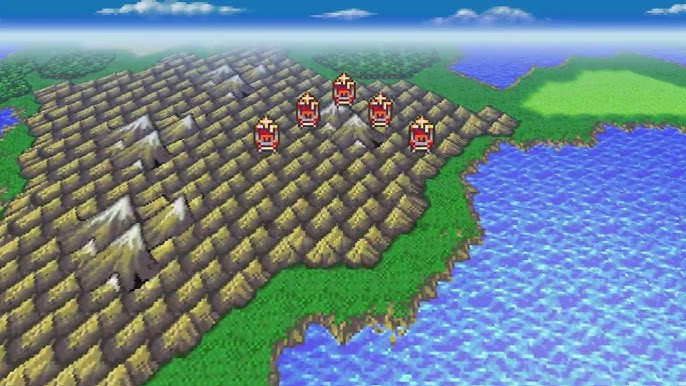
The Kingdom of Baron, the largest and most powerful kingdom on earth, has recently decided to conquer the rest of the planet. Sending its fleet of airships, The Red Wings, on a crusade to invade neighbouring kingdoms and steal their elemental crystals.
We open the game on one such attack. The Red Wings invade the mage town of Mysidia and are successful in stealing their crystal thanks to the power of their Dark Knight commander, Cecil Harvey. Cecil is also our main protagonist. How’s that for a shake-up. In previous games we were the heroes fighting against an invading force, and in this game we start as a member of an invading force.
It’s a dark intro seeing them cut down innocent mages. We don’t just see them cause property damage; we see them outright murder people. They aren’t afraid of showing the dark deeds these characters do. It’s a way darker introduction than any of the previous games, and yes that includes Final Fantasy II. Because unlike that game where we only really saw the attack for one battle, here we have an entire scene showing it. Plus, need I remind you the guy doing this is supposed to be the hero.
But see, Cecil isn’t evil. He might be a bad guy but he’s not a BAD guy. He and his men are actually shaken up by what they’ve done and are questioning why the king is even doing this. Because this militarization and conquest thing is a recent development that came out of nowhere. It was like the king became a completely different person one day.
Cecil even questions the king when he returns. Which gets him swiftly stripped of his title, relieved of his command and charged for treason. But he’s backed up by fellow Baron soldier and his ride or die bro, Kain the Dragoon, who manages to prevent the worst from happening.
Cecil and Kain are then given a new mission of delivering a Bomb Ring to the town of Mist. Well, that doesn’t seem suspicious at all. Seriously though, despite these two having clear misgivings on the kings’ actions, neither question the idea of delivering something called a BOMB Ring to a nearby town. That didn’t raise a red flag for you guys.
Well, it kind of does, but Cecil and Kain are both in an awkward position. They’re orphans that were effectively raised by the king. They owe him a life debt, and Cecil is torn between loyalty to the king and his own moral compass. He even became a Dark Knight on the king’s orders. Because again, he isn’t a bad person. He knows what he’s doing is wrong, but he can’t bring himself to go against his king/father figure.
Fortunately, Kain isn’t the only support Cecil has. He also has help from this games version of Cid who serves as the mechanic for the Red Wing fleet, and his girlfriend Rosa. Both of whom try to provide emotional support through Cecil’s bout of crippling self-loathing.
Already this game has done a lot of good character work. Cecil is obviously the main focus, being the main character and all, and within the first ten minutes he already has way more characterisation than all of the previous main characters combined. He’s a good man that deeply cares for his friends but is struggling through a crisis of conscience as his loyalty to his monarch is forcing him into doing evil deeds he doesn’t want to do. That’s a great starting point for a character arc.
Even the side characters are given far more personality and depth. Kain is like Cecil in that he’s torn by his loyalty to Baron while wanting to live up to his late father who was a great Dragoon. Cid is a crochety old coot who can be tough to deal with but has a big heart. And Rosa is just a total sweetheart and her relationship with Cecil is just really cute.
I also like there is an actual romance in this. III technically had one but it was very underdeveloped and boiled down to the player getting the princess at the end, and II had one but only in side-material and with creepy incestuous undertones. This is actually developed throughout the whole game, and they both have great chemistry. I actually buy that they are a loving couple.
Part of that is that the character writing is much better. The characters have actual defined personalities that infer how they interact with each other. This makes the cutscenes and character interactions a lot more engaging. Not every character is a winner, there’s some I find annoying and not everyone gets an arc, but at least I can say these characters have a personality. Which is more than I can say for the casts of previous games. Yes Final Fantasy II that was aimed directly at you.
After our two heroes set off on their mission, and we get a text scroll explaining everything we’ve just seen while the wonderful Final Fantasy theme plays, the adventure begins. Normally this is the part where I hit the shops to get some equipment, magic and items, but you don’t really need to do that here. The weapon and armour shops in Baron aren’t open, you can get more than enough items from Baron castle for this part of the game, and you don’t need to buy magic.
Yeah, this is the first game in the series where you don’t need to purchase magic. This is because magic is learned naturally as characters level up. That is, if the character is able to use magic to begin with. Because unlike in III where characters had swappable classes, here every character is locked to a singular class. Sort of, some characters are combinations of classes from past games. The point though is that, instead of focusing on classes, this game focuses on individual characters with their own unique abilities.
Every character plays a little differently from one another. They all have their own combat skills and certain equipment they can use. Because of that, there’s not as much customisation in this. You don’t really have much of a choice in what characters can use. You have some leeway in weapons since some characters have multiple weapon types to choose from, but even that doesn’t give you that much freedom
You really don’t have much you can do when it comes to building your team. Even what little freedom it offers doesn’t really matter in the end. You can’t really change how each character plays since they’re all locked into their own defined role. That said, each character is unique, and it is fun seeing what each character can do.
I’ll go over each character when I get to them, and I might as well cover the two we have right now. Cecil is the Dark Knight class. He doesn’t have much, he only has a basic attack and the Darkness command, which attacks every enemy on screen at the cost of some HP. He can also only wield dark weapons and armour, though thankfully you don’t have to wait half the game to get those.
Kain meanwhile is the Dragoon, and he does what every Dragoon does. He jumps. That’s pretty much all he’s about, jumping and coming back to earth for massive damage. He does have decent attack without it though, and a decent selection of armour making him a nice well-rounded front-line fighter. He’s pretty shallow as far as playstyle, but that’s Dragoons for you.
After heading out our heroes make their way to Mist. But since they lack airship privileges, the only way to get there is by heading through Mist Cave, which is guarded by a Mist Dragon. Can’t say they don’t stay on brand. It’s here where you get properly introduced to the game’s battle system. Because Final Fantasy IV would be the first appearance of the defining battle system of the Final Fantasy series, the Active Time Battle system or ATB.

The way it works is that every character has a meter, and when that meter is filled they can then take a turn in battle. How fast the meter fills is determined by the agility stat. So characters with higher agility will be able to go much quicker than those with lower agility. You also have spells that directly affect it. Haste now works by increasing the speed of the ATB Gauge, while spells like Slow decrease it. You also have Stop which freezes it entirely, which is also the case for status conditions like paralysis.
But just because your character can go doesn’t mean the battle has stopped. It’s called ACTIVE Time Battle for a reason. While you’re busy picking what move to do the fight is still ongoing. Enemies can still attack you even if it’s your move. If you take too long to pick what you want, you’ll wind up taking extra damage.
You also have to be mindful of the time it takes to perform certain actions. Stuff like basic attacks and using an item will come out right away, but character specific actions like Cecil’s Darkness ability or casting spells will take a little bit to activate, with some spells having a longer cast time to boot.
There can be a lot to keep track of, but it never gets overwhelming. You really have to stay on your toes with this system. There is still a strategic element to it obviously, it helps to have moves mapped out ahead of time, but you also have to be able to think on the fly and be able to adapt to situations in the moment.
But why do I say you’ll notice it more with the Mist Dragon? Well, that’s because the bosses utilise the ATB system in different ways. The bosses will actually change in real time, which also changes how you approach them. In the case of the Mist Dragon, they’ll be times when it turns into mist, and if you attack it while it’s in that state you get struck by lightning.
You can’t just mash attack and wail on the bosses. You need to pay attention and actually come up with a strategy to win. We’re far past the days where we can just Berserk our way through every boss. The bosses require a far greater variety of strategies and are a lot more engaging because of it.
I love this system. It has the strategic elements I love in turn-based battles, but with a faster pace and more frantic energy. Admittedly it can be a little frustrating when you have to wade through tons of spells and items to get what you want. Especially since those lists can get cluttered very quickly. Here’s a tip, make sure you keep things organised. Take advantage of the Sort feature because it will make finding what you need so much easier. It isn’t perfect, the spell list will always be a little messy, but it’s much better to be partially organised than having no organisation at all.
Fortunately, the ATB system is very adjustable. You can adjust battle speed to make things slower or faster, and you have two different options when it comes to spells and items. Active which keeps things going and Wait which will freeze battles while in the magic or item menus to let you take your time.
It’s very accessible in that regard. It’s completely customisable to your own skill level. Personally, I thought the base speed was fine enough, and I did find Active ok early on, but switched to Wait midway through when I got more spells. It gets a little bit too much with the number of spells and items you get in this game. It’s a system that’s very easy to get into. For all the issues I have with this game, the battle system is the one bright spot I can’t argue against.
This system was the brainchild of Hiroyuki Ito who took inspiration from Formula One racing. Of all things. Seeing the different speeds of the race cars made him want to create a system that reflected the different speeds of the characters. Inspiration can come from strange places I guess. The ATB system would prove to be very popular. so much so that it would be the battle system for the next six games and would even be used in other Square projects.
After dealing with the dragon, Cecil arrives at Mist where the true nature of his mission is finally revealed to him. The Bomb Ring was indeed an explosive device. Or rather it contained a bunch of exploding devices. The ring unleashes a horde of Bomb enemies that proceed to lay waste to the entire town.
He also meets a young girl crying over her dead mother, but the mother didn’t die during the attack. The mother died when her summon died. A summon that acted as a guard of the cave. Oh dear. Cecil and Kain then realise the reason behind the attack. Mist is a town of summoners and the king wanted to wipe them out so they wouldn’t oppose him.
This is the final straw for Cecil. Horrified by what he’s done and realising that Baron has gone too far he defects and chooses to fight against them. Interestingly, Kain agrees to go with him, but not before he insists they kill the kid because that’s what they were ordered to do. He was faking this as a test for Cecil’s resolve but remember this for later.
With the duo now rebels, they realise that if they want to take down Baron they are going to need to get help from the other nations. Since they can’t exactly wage a two-man war against the most powerful military force on the planet. I mean they probably could, but this isn’t a game like Contra where that shit might actually work. This game has an actual narrative where actions have consequences. They need to be smart about this.
They also decide to take the girl with them. They can’t exactly leave her in the smouldering ruins of her town, and they are responsible for killing her mom, so they have a moral obligation to take care of her. The girl isn’t too keen on going with her mother’s killers though, and the stress of the whole situation causes her latent summoning powers to awaken. Calling Titan in her rage who causes a massive earthquake that scatters the group.
Cecil awakens in a field with the girl. Kain is nowhere to be found, and the earthquake created a rock formation blocking the way back to Mist. Since he has no way of looking for his bro, Cecil decides to take the girl to rest at the nearby desert town of Kaipo. He tries to reassure the girl that he does intend to protect her, but she’s not buying it. It’s not until he defends her from some Baron soldiers that she realises that deep down he is a good person. Finally trusting him enough to tell him her name, Rydia.

I really like this moment. While a lot does happen in the short amount of time you reach Mist, the game is incredibly efficient at getting a lot of information across very quickly without it ever feeling rushed. Even if the bombing is predictable if you thought about it for even a minute it’s still a harrowing scene. We did see towns being bombed in Final Fantasy II, but only the aftermath. This puts us right in the middle of it.
It’s a powerful and emotional moment. You can really feel the anger and resentment Cecil has for what he did, and Rydia’s sorrow over the loss of her mother and home. I also like that Rydia doesn’t trust Cecil at the start. Not only does that make sense given the context, but it makes for more engaging drama. It’s not like in the previous games where they went to a guy, talked to them, and they immediately became allies.
It’s more believable that Cecil needs to earn Rydia’s trust. This isn’t the case for just Rydia either. Many of the later party members will also not immediately like Cecil. They’ll often only team up with him either to accomplish their own goal, or because he helped them out and earned their trust. The only characters that do trust Cecil from the start are Rosa, Cid and Kain, and that’s because he has a history with them.
It helps make the world feel lived in and real. There’s a history to these people; they all have different goals to accomplish. They may be united under a common cause, but their motivations for joining that cause do vary. It isn’t like the past games where everyone shared a common goal and backstory. Everyone has their own history that informs who they are, which in turn informs how they interact with the story. It creates some very engaging character drama.
This is what makes Final Fantasy IV so beloved. It was the first game to add a sense of drama and pathos to the story. II tried to do it but ultimately failed due to how underdeveloped everything was. Like, II had entire towns wiped off the map during its story and yet that had less emotional resonance than the destruction of Mist. Despite you being able to visit Mist later on and it being perfectly fine.
A big reason for that is because of how it affects the characters. Sure, seeing entire cities and their populations being wiped out in II is certainly shocking, but we never see the characters react to it. They never reacted to anything, so it all landed with a resounding “well shit, that just happened”. Even if it was to create an emotional impact in the player due to not being able to go back to towns they’ve visited, it falls flat since the towns in II were bland and nondescript. You never cared about them because they weren’t very memorable, and no amount of revisits helped with that.
In IV though, the towns have a little bit more of an identity. Making it easier to create an emotional attachment to them. Not a big one, but at least you can more easily remember the places you visit. Plus, the characters actually react to things. We see how the destruction of Mist affects Cecil and since we like Cecil it’s easy to feel as disturbed as he is by the senseless destruction.
Even Rydia is easy to sympathise with even if we don’t know much about her. She’s a little girl who just lost everything. You can easily empathise with her feelings since you’d probably feel the same way in her position. You know assuming you’re not a complete sociopath.
Now I have my issues with the story that we will get into, but when it does go for a big emotional moment, it can stick the landing. Even if Final Fantasy stories don’t make much sense if you really dissect them, they do succeed when it comes to getting an emotional response from the player.
Since that’s all done and dusted, you can finally start looking around the town. This is where you can start buying equipment for the party. As I said though there isn’t much customisation, but we can at least upgrade our kit. As I mentioned earlier though characters do have multiple types of weapons they can pick from. In Rydia’s case she can either wield a rod or a bow and arrow.
I stuck with the latter since Rydia is a mage who I kept in the back row for pretty much the whole adventure, but there is a benefit to using staffs and rods in this game since they increase the Intelligence and Spirit stats which makes magic stronger. Admittedly the differences become negligible by the end, but at least there’s a benefit to using Rods and Staffs in this game. Plus, since you don’t need to level up weapons, you don’t really have to worry about attacking with those anyway.
Speaking of Rydia, she’s one of your main magic users. She’s able to cast White and Black Magic along with being able to call Summons. She’s very versatile, at least once you start unlocking spells. Since she starts at level 1 and can’t do much until you level her up.
Interestingly though, Rydia never learns any new summons by levelling up. She’s stuck with Chocobo and won’t get her other summon monsters until much later. She also can’t use Chocobo that much since it costs 7 MP and her MP reserves are very low at the start. This helps add to the storytelling since it shows through gameplay that Rydia isn’t that skilled when it comes to her summoning magic. Which is a concept the game will use again later on.
But to back pedal a little, Final Fantasy IV would see the return of MP. For good this time, we won’t be seeing spell charges again. But it’s been greatly improved since it’s debut in II. Spells now all have different costs. It’s not uniform like in II, and more powerful spells will cost a lot more MP. So there’s a better degree of resource management when it comes to casting spells, while also providing more resources to play around with than the more confining spell charges. It makes spellcasting a lot easier to experiment with.
Looking around town, Cecil discovers that Rosa is also there. She went out looking for him after he left Baron, because she’s a good girl who worries about those she cares about. But her trek through the desert has caused her to come down with a case of Desert Fever. Which can only be cured by a Sand Pearl found in Damcyan.
Now, how Rosa got here before us is anyone’s guess. Geographically it makes no sense that she’d be able to get here at all, there’s literally no way she could have physically walked here, and if she took an airship then how did she get Desert Fever. Did the ship just drop her off in the middle of the desert. By all accounts it doesn’t make sense.
But Cecil doesn’t really question this since he’s more focused on not wanting to see his future baby momma succumb to a plot hole induced disease. So he heads off to Damcyan to retrieve the pearl. While travelling through the underground waterway leading to it, he runs into Tellah. A powerful Sage from Kaipo who is also heading to Damcyan because his daughter Anna recently ran away with a Damcyan bard.
Despite being a renowned magic user, Tellah is incredibly old and not quite what he used to be. He proposes they team up to get through the cave and deal with the giant monster guarding the exit. We also get a brief scene midway through the dungeon where the characters make camp that doesn’t add much, but it’s a nice little scene that adds a little more characterisation and introduces a big new feature of Final Fantasy IV. Being able to save and rest in dungeons.
This is a game changer. These save points make the dungeons a lot more manageable. While the dungeons are still long and exhausting, being able to rest to heal up and save during them makes them a lot less strenuous. They can still be a challenge, but at least they don’t make you do it all in one long run. You’ll want to bring a lot of Tents and Cottages because you’ll be making frequent use out of them.
Tellah joins the party for a bit, and he sadly sucks. He’s a magic user like Rydia, but his old age means he’s forgotten most of his spells. His main gimmick is the command Recall where he tries to remember and cast a random spell, which in my experience means he either does nothing or will just cast a spell I can use from the menu anyway. You’re better off ignoring it and just casting the spells he can remember. It should be enough to get you through this.
After making their way through the cave and dealing with the giant octopus at the end, the party makes it to Damcyan. Only to bear witness to the Red Wings bombing the castle and making off with the crystal. Entering the castle doesn’t make things any better. There are dead bodies everywhere, including Anna.
They also find the bard she ran off with and in a rage Tellah beats the crap out of him. Delivering one of the most famous lines in the entire franchise, “You Spoony Bard!”. I love that through all the various updated translations this game has received over the years they always made sure to keep this dumb little line in. Because let’s be honest, you can’t improve on perfection.

Anna is only mostly dead though, and with her last words she’s able to tell her father that the bard is actually the prince of Damcyan, Edward Chris von Muir. You can tell he’s royalty because he has three names. He disguised himself as a bard to avoid attention while he was out exploring. Which doesn’t make a whole lot of sense since bards are all about attention, but he does like playing music so I guess I can see the reasoning.
Edward gives a little more detail on what happened. The Red Wings were led by a man clad in dark armour named Golbez who laid waste to the entire kingdom. Edward’s parents were killed, and Anna died protecting him from the Baron soldiers because the two were genuinely in love. Hearing this, Tellah forgives Anna before she passes on, only to then storm off to get revenge on Golbez.
It’s a very dramatic scene but it’s undermined by what happens next. While Edward is mourning his lost love, Rydia starts acting like a total bitch. She calls him a coward and to man up. The dude is besieged by paralysing guilt, and Rydia just brow beats him into action. It’s so needlessly mean I can’t help but laugh at it.
Edward does get over the shock and agrees to go with them to get the Sand Pearl. Edward is a pretty weak character stats wise, acting more as a support class. His main gimmick is playing a variety of songs that can debilitate enemies with status effects. He can also split a potions effect across the whole party (though I admittedly didn’t find out about that until after I beat the game) and he can hide off screen with the Hide command or when he’s at low health. Yeah, Rydia wasn’t far off the mark, Edward is a pretty big coward.
The Sand Ruby is in an Antilon Cave, but the only way to get there is with Edwards Hovercraft. You read that right; Edward has a hovercraft ripped right out of Star Wars. Really makes me question the technological level in this world. You use the craft to get the Ruby and return to Kaipo to heal Rosa.
Rosa reveals she went out looking for Cecil after hearing he died in the Mist quake, and that Golbez was appointed leader of the Red Wings not long after he left Baron. She also suspects that Golbez has been manipulating the king and is the mastermind behind everything. Since Golbez is going after the world’s crystals, they determine the next place he’ll strike is Fabul.
Despite still recovering from a sickness, Rosa decides to go with us and lend a hand. If I haven’t made it clear by now, Rosa is my favourite character in this. Bitch literally just got over a deadly illness and still pushes herself onward just to help protect the man she loves. Rosa kicks ass.
She’s also one of the best characters in terms of gameplay too. Rosa is the de facto White Mage. She’s the girl that keeps the party in prime condition with healing and buffing magic. She also has the Pray command which can heal the entire party for free, but it only works half the time. Like in real life it’s best not to rely on prayer too much.
Rosa isn’t just a White Mage; she also doubles as a ranger too. She’s pretty handy with a bow and arrow and her Aim command allows her to hit enemies for a decent amount of damage. She’s not the best damage dealer, but she can dish it out when need be and she decimates flying enemies. Her only drawback is weaker defence, but since she’ll be in the back row anyway that doesn’t matter. She’s just an awesome character.
After this there’s a really sweet scene involving Edward. He’s singing out by the lake at night pining over Anna when he’s attacked by a monster. During the fight, Anna’s ghost appears to encourage him, telling him that he needs to fight on and believe in himself. She’s also able to say her proper goodbyes and leave the mortal world.
There’s a lot of these types of scenes. Smaller moments where the characters are just allowed to reflect. These are often the moments in stories I like the most because it really lets us get to know the characters on a deeper level. I remember playing an Action RPG called Illusion of Gaia, and I remember there was this one part where it was just these two characters lost at sea. It wasn’t a very exciting scene, not much actually happened in it, and yet it was one of the best parts of the game because of how strong the emotions were.
This scene with Edward is a lot like that. It’s just a short simple scene, but the emotions are so strong that it sticks with you. A lot of this is helped by the strong presentation. The music is spectacular. This is easily the best soundtrack so far with some amazing music that really makes the emotional moments hit hard, while also being very action packed and exciting too.
But the visuals also help sell a lot of the emotions. Obviously since we’re going from 8-bit to 16-bit there’s a massive jump in graphical fidelity. Everything has a lot more detail and colour to it compared to the NES games, at least if we’re comparing the original releases. If we look at the remakes then it’s not as big a leap, but a lot of the remakes are based on the framework established by IV.
But I’m not just talking about the graphical fidelity. There’s more to Final Fantasy’s visual presentation than just the graphics. Final Fantasy IV was the first game to properly embrace the use of what I call Sprite Pantomime. Which is basically where you see the sprites on the overworld move around to act out a scene.
While this kind of thing was in II and III, it was IV where it became properly established in my eyes. Having more animations and expressions for the characters. While it’s not as elaborate as it would get later on, just wait until we get to VI it’s going to go ham with it there, the added expressions and animation make the story a lot more visually engaging.
One thing that impressed me was how they were able to convey a lot of emotion despite how limited a lot of the animation is. Honestly the overworld sprites aren’t too far removed from the NES games. They’re more detailed, but they are still very simple, especially compared to later 16-bit RPGs.
But thanks to clever use of what animations they have, combined with the strong writing and dialogue, and you can almost read the subtle expressions they make even if they aren’t really making them. A lot of it is open to the imagination, but the fact they were able to convey a wide range of emotions with simple animations and clever writing shows how much passion went into this.

The party then heads to Fabul, but there’s a problem. Mt Hobs that leads to Fabul is blocked by a massive wall of ice. Now the ice is easily meltable by the Fire spell, but Rydia can’t cast it. Not because it’s hard, it’s the easiest spell to learn, but because she has an aversion to fire after seeing her village burn down. This fear is reflected in gameplay since Fire isn’t a spell Rydia can use.
Fortunately, the gang is able to perk Rydia up, and she casts Fire to get rid of the ice. If I make it seem trivial, that’s only because the game makes it seem that way. Rydia is dealing with a major traumatic experience, something that can take people years to overcome. But in Final Fantasy IV, they basically just give her a pep talk and then it’s over. She can cast Fire now. It’s resolved so comically quick you’re liable to get whiplash from it.
But after breaking the ice, the party can climb the mountain. Along the way they run into a monk from Fabul named Yang in battle with a bunch of monsters. He explains that he was training with his men when they were all jumped and killed by a group of monsters. The party explains they were sent by Golbez, and he agrees to go with them to warn the king.
Now, if you’ve been paying attention then you may have realised our party currently consists of Cecil, Rydia, Edward, Rosa and now Yang. Meaning our team now has a total of five characters. That’s because Final Fantasy IV has increased the maximum party size from four to five. I guess because the game was on a more powerful system they wanted to make everything seem bigger, even in how many characters are in combat.
Well it may be bigger, but I wouldn’t say it’s better. Having five characters makes it harder to keep track of what’s going on. You wouldn’t think adding one extra character would make that much of a difference, but it does. In game design even a small addition can completely alter how a game plays.
Now I could handle having five characters if the battles worked like the previous games. But with the ATB system it makes everything more chaotic and messier. I would sometimes get mixed up in which character was going next, not helped by the fact that multiple characters have the White Magic command which leads to some confusion. You have to pay a lot more attention which can be mentally exhausting and more than a little stressful in the more difficult fights.
This is the only game to have five-character parties. I think Square realised it was a bit too much and subsequent games would go back to having four-character parties, at least until the 3D games. Still, it does make IV stand out at least.
But let’s talk about that new character now. Yang is this games version of the Black Belt from III. He’s a powerful physical fighter that can dole out a lot of damage, and he has the Kick command for crowd control, though it isn’t quite as powerful as before. The Focus command was also reworked. It now does one big attack rather than powerup the next one. Ok, so it basically works the same, it’s just been streamlined a bit.
He also has the Brace command which works like a better Defence, though you will never use it. Like most Monk character Yang is all about offence and less about defence. He isn’t as well rounded as some of the other characters, and honestly in terms of offensive damage dealers he’s outclassed by others in the late game. But he definitely pulls his weight when needed.
After making their way to Fabul and warning the king of Golbez and his upcoming assault, our gang prepares to defend the crystal. It doesn’t go well. While they’re able to hold them off for a time, the Red Wings are simply too strong, and they push their way into the crystal room. Fortunately, Kain shows up. Aww great some back up. And then he attacks us. Shit!
Yup, Kain is brainwashed and on the villain’s side now. But just when you thought things couldn’t get worse, the big bad himself shows up, and boy does he make an impression. Not only does he have an amazing villain theme and a wickedly cool design, but he’s a powerful motherfucker. He wipes out the rest of the team in just one shot. If they wanted to make Golbez intimidating, then mission accomplished.
So Golbez gets the crystal, and to rub salt in the wound he also takes Rosa. No reason why he does it, he just sees how much Cecil likes her and takes her just to mess with him. What an asshole. The only positive in this whole thing is that he doesn’t kill us, which seems kind of stupid, but there is a reason behind this that won’t get revealed until much later on. So it’s not as stupid as other examples of this trope.
So, that was a complete disaster. But there’s no time for moping around. While resting off their wounds the gang realises the only way they’re going to get Rosa back is if they get an airship. But the only kingdom with airship technology is Baron, so they’ll have to sneak in and borrow one. Fortunately, Baron’s naval power sucks, so they decide to take a boat and head in by sea.

So it’s off to Baron, and almost immediately things go pear shaped. The ship is attacked by Leviathan and a massive whirlpool starts dragging everyone in. Rydia falls overboard, Yang jumps off to rescue her, Edward falls off not long after, and the boat is swallowed by the sea. Cecil then wakes up far from his intended destination with all of his allies scattered to the winds.
Ok, I think now is a good time to mention my biggest issue with Final Fantasy IV. You have no control over the party whatsoever. I already mentioned the lacking customisation earlier, but the truth is, that’s normal. A lot of old school RPG’s, hell a lot of modern RPGs even, don’t give you that many customisation options when it comes to equipment. You just use whatever your class can and update to better stuff as the game progresses.
Some offer more, like Paper Mario’s Badges for example, but most get their customisation via other methods. In Final Fantasy’s case you had the job system in the older titles, and if I may get a little ahead of myself, later games give you multiple party members you could swap between. You were given methods of altering the party to suit your own personal playstyle.
But IV doesn’t give you either option. The characters are all stuck as the same class, and you can’t edit who is in the party at all. Your team will be whatever the game gives you and you can’t do anything about it. If a character leaves the party that’s it, they’re gone for good. Aside from some rare exceptions most party members won’t return once they leave. Edgar for example is gone now. You can’t play as him anymore. Because of that, Final Fantasy IV is one of the least customisable RPG’s I’ve personally played. You have almost no freedom in how you build your team.
You can’t even change the rows in combat to your liking. You can only switch between two modes, three front two back, two front three back. They took the ability to change the frigging rows from us. I really have to question if that was necessary. The set-ups they give you are enough, but why not just let us pick the rows ourselves. It’s so strict for no good reason.
The only thing you can still change are the names of the characters. There’s an NPC that pops up in various towns called Namingway that lets you rename the characters. While I appreciate having the option, it feels pointless given the characters have established personalities and backstories. You can’t even rename them when they enter the party. You can only do it via this Namingway guy. Which just makes it feel awkward in terms of the story. Like the characters are just giving themselves random name changes for no discernible reason.
Look, there’s nothing wrong with having an RPG with less customisation. Final Fantasy IV is a more story driven game; you could even argue it’s meant to be a more cinematic kind of experience. Or as cinematic as a 16-bit RPG can get. Plus, it has a great combat system and a fun world to explore. So it still has two of the other things I look for in an RPG.
However, I am one of those people who values strong customisation in RPGs. Some of my favourite RPGs are ones that let you make a ton of different builds. It’s why I love Bravely Default so much, it’s one of the reasons I love Paper Mario the Thousand Year Door. Even games like Chrono Trigger or Pokémon which aren’t that heavy with customisation still let you create your own teams with a lot of fun combinations.
So to see Final Fantasy IV lack in this department does disappoint me. I can understand why they designed it this way, but that doesn’t mean I like it. The lack of any player expression is something I can’t fully get over. I have heard that some of the other versions do let you swap out party members to make your own team, but it’s not in the Pixel Remaster, so I can’t say anything about it.
But I digress. After waking up, Cecil stumbles his way to the only town nearby, Mysidia. The town he invaded at the beginning of the game. He is really not having a good day is he. This part is great because no one in Mysidia likes Cecil for very obvious reasons, so a lot of the NPCs are super hostile and will inflict a bunch of status ailments on you if you talk to them. It’s pretty funny.
Cecil goes to speak to the Mysidian elder to explain what is going on. The elder then tells him that if he wants to have any chance of defeating Golbez, he needs to forgo the power of darkness and instead except the power of light. To do that he’ll need to perform a ritual on Mt Ordeal. He sends Cecil there along with two young magical prodigies, Palom and Porom.
Palom acts as a Black Mage and Porom is a White Mage. Not much to make them stand out, especially given how many mages are in this game, but they both have a unique command that makes them a bit more unique. Palom has Bluff which powers up the next spell he casts, while Parom has Cry which can debilitate enemies. Both also have Twincast which combines their powers to cast a powerful spell on all enemies. This is mostly what you’ll be spamming with these two since it’s relatively cheap and will end most encounters quickly.
While climbing the mountain, the gang also runs into Tellah again. He’s travelled up here in search of the spell Meteor which is said to be the strongest spell in the world so he can kill Golbez. Hey whatever happened to Ultima? That was introduced as the most powerful spell in II and it hasn’t reappeared since. It is in the 3D version of IV as a Twincast, but not in the original. I thought it would reappear a lot more, but I guess not.
Seeing as how everyone is going the same direction, he rejoins the party. Meanwhile at the Legion of Doom, Golbez is aware of where Cecil is going and decides to send one of his four elemental lords after him. These are basically IV’s equivalent of the Four Fiends, which makes me wonder why they don’t just call them that. I think they were named that in the original translation, on the wiki they’re referred to as Archfiends so it’s entirely possible, but it’s been a long time since I played that so I have no idea.
The real question I have is how in the hell Golbez knows about this. Seriously, this is never explained. He just somehow knows where Cecil is and what it is he’s doing. I know Golbez is meant to be a powerful wizard, but there’s nothing to indicate he has any clairvoyance. Does he have spies in the area? Did he bug Cecil? How is he doing this.
Our team climbs to the top of the mountain and face the elemental lord of earth, Scarmiglione, who they swiftly defeat. But when they head to the shrine for the ritual, sike, he comes back in a second phase. The game does this a lot. it will have a number of moments where you fight one boss and then immediately fight another. This is where it gets most of its challenge from.
To be honest, I don’t find IV to be all that challenging. A lot of the difficulty it has comes more from beginner’s traps than anything. Like it gets most of the difficulty from catching the player off guard than it does testing their skills. If you play cautiously like me and try to plan ahead, nothing should pose much of a threat. I know RPG’s do tend to rely on trial and error for their difficulty, but this feels cheap most of the time.
After beating the boss twice, Cecil enters the chamber where he’s told in order to receive the power of light he must face his inner darkness. And I mean that literally, he has to fight the embodiment of his Dark Knight powers. Well, not really fight it. You’re actually supposed to just defend against it and eventually you win. I get they were going for a zen thing where you can’t fight the darkness in you but accept it, think how Mad Jack was defeated in Samurai Jack, but it’s a little clunky in execution. The game didn’t give me any feedback, so I didn’t know if I was doing it right. It took me longer than it should have to finish this part.
But eventually, Cecil overcomes the darkness in him and becomes a Paladin. He’s also greeted by a mysterious light who calls him his son. With Cecil being oblivious as to who it is. Really? I mean it’s pretty obvious that it’s his dad. Why else would he call him son. Why is Cecil is completely oblivious to this. I’m beginning to think Cecil isn’t very bright. I had my suspicions with the whole Bomb Ring incident, but I think this just confirmed it.
But now that he’s a Paladin Cecil gains an entire new set of abilities. He basically becomes a mix of the Knight classes from I and III. He can defend allies when they’re at low health, but he also has a Cover command that will let him defend a chosen ally whenever you want, and he can cast some healing magic. He can’t cast much of it, and he’s not that proficient at it, but it is helpful to have a secondary healer for dungeons.
He still largely plays the same. Being a physical fighter with good attack and defence, but he’s a lot more versatile now. He also gains access to better equipment, on top of having a better variety of weapons he can wield. You’ll still generally stick to swords, but he has a few other weapon types he can use.
I should bring up though that IV was the first game to limit dual wielding. Every character has a dominant hand and can only wield a weapon in that, with the secondary hand only being able to equip a shield. Only two characters can dual wield. The first is Yang, who doesn’t really count since he’s a martial artist who uses claws, and the other we will get to later.
It’s for the best that they did this. Dual wielding was busted in the previous games, and this helps balance things somewhat. Later games would use different methods of doing this, including axing the concept entirely, but it’s nice to see the series is trying to fix some of it’s more broken elements.
In fact, I’d say that Final Fantasy IV is the most balanced game in the series so far. Granted a lot of that is due to the lack of customization, but a lot of the more broken strategies in the last few games have been adjusted here. It’s not quite as easy to break.

But back to the plot. Tellah also manages to remember all of his old spells, including Meteor. Despite this though, he still can’t actually cast it. See that spell costs 99 MP and Tellah’s MP caps at 90. From a story perspective this is clever. They make a big deal of how powerful Meteor is, and that casting it would be too much for Tellah to handle. This is a great way of using the gameplay to actually show that.
The problem is that it makes Tellah a really crappy mage. He doesn’t have the MP to frequently cast the higher-level spells, which can cost 30 MP or more. So despite having access to some very powerful late game spells, Tellah won’t be able to actually use any of them that often. I know they couldn’t have him spam Meteor for story reasons, but there had to be a better way to prevent that than gimping him this badly.
But now that Cecil is a Paladin, they can make their way back to Mysidia. One thing to note is Cecil actually goes back to level 1 after becoming a Paladin. Which sounds annoying, but it doesn’t take long to level him back up. I also think it’s good design to prevent you from teleporting back down, making the player walk down the mountain. Yes, it’s annoying having to walk back through a dungeon, but it gives you the opportunity to level Cecil up. So it makes sense why they make you do that here.
Plus, it makes sense from a story perspective to have Cecil reset his levels. Him becoming a Paladin is meant to be him starting again on a new path and this uses the gameplay to symbolise that. Final Fantasy IV is really good at that isn’t it. Actually using the mechanics as part of its storytelling. It adds a level of immersion you didn’t see in a lot of RPGs at the time.
After making their way back to Mysidia, the elder is impressed on Cecil’s transformation and becomes convinced that he is the one spoken of in a Mysidian prophecy. Which tells of one born from a dragon that will save the world from darkness. Now that he’s proved himself, the elder grants the team access to the Devils Road connecting Mysidia to Baron. Finally letting us get back to our original mission.
Palom and Porom also admit they were sent to spy on Cecil. But thanks to proving himself they’ve grown to truly respect the guy and decide to help him out for real. The Mysidian elder meanwhile decides to go and pray. Remember this, it will be important later.
After arriving back in Baron, they find that Yang is still alive. But he’s gotten amnesia and is now trying to capture the party. Fortunately his amnesia works on Hannah Barbera logic since after a few good blows to the head he’s back to normal. Yang explains that after he jumped in to save Rydia, she was swallowed by Leviathan and the two got separated. So he has no idea if she is still alive or not.
On a more positive note, since he was part of Baron’s military even if it was only for a brief period, Yang has a key that can open a secret back entrance into the castle. They head in and confront the king. Who turns out wasn’t the king, but the water fiend Cagnazzo. He murdered the real king and has been impersonating him the entire time.
This fight is stupidly easy by the way. All I did was spam Thunder magic and he went down so quickly I didn’t even notice there was a boss fight. Mind you, there is a boss right before this one that is tougher and will likely drain your resources, but if you heal up beforehand, you can just nuke the dude and win in three turns. See what I mean when I said most of the challenge comes from beginner’s traps.
After that’s done, Cid shows up. He had been arrested for speaking out and was just about to deal with the king himself. He’s late to the party though, but now that he’s here he decides to lend us a new airship he has stashed away. But right after the party leaves the throne room, a trap left by Cagnazzo activates and the walls start closing in on them. In order to save everyone, Palom and Porom turn themselves to stone to halt the walls path.
They try to cure them with Esuna, but it doesn’t work for whatever reason. Apparently because they turned themselves to stone willingly they can’t be cured. Which is kind of a stupid rule. Does that mean if I cast poison on myself then I can’t cure it, or that if I decide to cause grievous bodily harm to myself then no magic could heal me since it was self-inflicted? I don’t like the implications this brings.
Really this is just an excuse to get Palom and Porom to leave the party. It’s a pretty sad moment at the time but it’s just annoying now. You’ll see why later. Since there’s nothing they can do, the party just leaves the two there and Cid shows us to his secret airship, the Enterprise. An Enterprise for the next generation you could say.
Cid also joins the party at this point. He isn’t great though. He hits decently hard, but his only ability is Analyse which scans an enemy to give you the rundown on their stats and weaknesses. Not a bad ability, but you can get a spell a little later that does the exact same thing, so it isn’t too special. The 3D remake gave him an extra command, but I didn’t play that version so I can’t comment on it.
As soon as you start flying the Enterprise, Kain and the Red Wings show up to offer a proposal. They will return Rosa in exchange for the final crystal. Despite this being the oldest trick in the book, Cecil is worried about Rosa and heads to Troia to obtain it. But when they get there, they find out the crystal was already stolen by a Dark Elf. They also find Edward alive and well, although he’s in no condition to fight. But he does provide us with a Twin Harp which will aid us in defeating the elf.
Now the Dark Elf is hold up in a cave somewhere, but there’s no where near the cave for the airship to land. In order to get there, you need to head to a Chocobo forest and get a Black Chocobo. This is a special kind of Chocobo that can actually fly, although it can only land in forests. This was the first game to introduce different kinds of Chocobo, there’s also White Chocobo that recover MP, and we’ll be seeing a few more Chocobo types as the series progresses.
The Fat Chocobo returns too, but like last time he’s been rendered useless thanks to the Pixel Remaster giving you infinite inventory space. While we’re on the subject of returning creatures though, Moogles strangely do not make an appearance in this game. Making this the only game since their debut to not have a Moogle in any way. I guess they weren’t as convinced on Moogles as they were with Chocobo.
But you get the Black Chocobo and head to the cave with the Dark Elf, and this part is a little annoying. See the Dark Elf is weak to metallic weapons and in order to prevent those from being used against him he’s gone full Magneto and created a magnetic field within the cave. If you’re characters are wielding any kind of metallic equipment they get paralysed during battle, and if everyone gets paralysed then its game over.
It isn’t that this dungeon is hard because it isn’t. As I said nothing in this game is all that challenging, I just find it annoying when a game forces you to change your set-ups like this. Thankfully this is the only instance where you have to do this, so at least it isn’t as bad as III was.
You make it to the Dark Elf, and he completely obliterates us. Without a sword Cecil can’t do anything, and his magic is simply too powerful. But that’s when Edward comes in with the save. He plays a magic song on his harp that reverberates in the harp he gave us, and that weakens the Dark Elf enough for us to re-equip our stuff and kill him. Yes, we kill the evil elf with the power of song. For as dark as the story gets, I’m glad it hasn’t lost its whimsical charm.
Since we got the crystal back the Troian’s allow us to borrow it for a time. Edward and Tellah also come to an understanding, with Tellah forgiving Edward over Anna’s death and Edward being able to move on from it. It’s a nice conclusion to Edward’s character arc.
Now that we have the crystal, it’s time for the exchange. After we take off in the Enterprise, Kain reappears to take us to Golbez’s base, the Tower of Zot. By this point I’ve played enough of this series to know that if I see a tower, it’s going to involve a long climb of multiple floors filled with enemies. I don’t know, maybe I’m not yet over the Crystal Tower from III, but these kinds of dungeons aren’t doing it for me.
One interesting thing to note about this place is that it’s the first place you fight the Magus Sisters. A trio of female magic users that will appear a few more times in this series. They’re Final Fantasy’s take on the evil trio idea. You know like Team Rocket or the Doronjo gang, if anyone knows who that is.

But after making our way to Golbez, yeah he still doesn’t release Rosa. He acts all coy and pretends he has no idea what we’re talking about. I mean this was obviously going to happen, anyone with any knowledge on storytelling knew the villain was going to go back on his word, but the dickish way Golbez did it was hilarious. If you’re going to be cliché at least have fun with it you know.
But before anything else happens, Tellah flies into a berserker rage and just starts lobbing spells at Golbez. None of it works, which forces Tellah to cast Meteor. The spell doesn’t kill Golbez, but it does weaken him enough that Kain is freed from his control. So the spell wasn’t cast entirely in vain, but as was warned, Tellah dies from casting it. Telling Cecil to avenge his and Anna’s deaths.
The party then heads up deeper and rescue Rosa who was strapped to a guillotine? Jesus these guys don’t mess around do they. But Rosa is saved and Kain then rejoins the group in an attempt to atone for his crimes, but before they can leave they’re attacked by the wind fiend Barbariccia. They beat her and this causes the tower to start collapsing, But Rosa knows Teleport, so she sends us back to Baron.
Why didn’t she just do that before? Probably would have been a lot easier. In fact, why didn’t she just teleport out when she was being kidnapped, or even while Golbez had her. What was preventing her from doing so. This is why teleportation is such a bullshit superpower. Unless you define limits on how it works it becomes stupidly overpowered, which makes characters look dumb when they don’t take full advantage of it.
Now that Kain is back he reveals what Golbez’s goal is. Turns out he wants the crystals to open a gateway to the moon to obtain… something. It’s not entirely clear what he wants, but it can’t be good. Fortunately, he still hasn’t gotten all of the crystals yet. For you see there are in fact eight crystals in this world, four light crystals on the surface, and four dark crystals in the underworld. That is the world under the ground and not the world of the dead, although that would have been much cooler.
Kain gives us a Magma Rock that can open the way to the underworld but doesn’t actually know where to use it. The game never actually tells you where to go, you just have to wander around until you find the place to go. I had already stumbled upon it earlier while I was exploring, but if you were only heading to where the story told you to go, then it’s time to get hunting.

I’m of two minds on this. On the one hand I hate it when a game doesn’t provide you with any guidance of where to go next. Not that I need the game to handhold me through everything, but the game could have provided me with some kind of direction. On the other hand, I don’t mind it too much in this instance. Because it incentivises you to actually explore the world and doing so you discover there’s quite a few optional areas to visit.
There’s entire towns, dungeons, and quest lines that can be very easily missed if you only follow the basic story. While the previous games all had side content to varying degrees, IV really goes all out on it. While it may not hold a candle to later games in terms of optional content, it was the first game that seemed to understand the importance of it.
Side content isn’t there to make a game longer. Ok it is, but it shouldn’t just be that. Good side content can help add to the world building. Enriching the world with smaller areas that may not be important in the grand scheme of things, but help make the world feel richer and lived in. While also making the exploration feel more rewarding.
There’s a certain satisfaction you get from finding something on your own rather than being told where to go next. It’s why playing games with a walkthrough isn’t nearly as satisfying as playing it on your own. Not that there’s any shame in using a guide, but it feels much better when you find something due to your own curiosity and skill.
Now, for the sake of time, because look how long this review is, I won’t go over everything the game has to offer, but I will cover some of the more important side content as we get to it. Especially since some of the optional dungeons do tie into the story and I would be remiss not to mention those.
But the story must continue. So what you need to do is head to Agart and drop the Magma Stone down a well. This causes a volcanic eruption that opens the way underground and probably should have killed everyone too. Seriously, an eruption needed to create a massive gaping hole underground should have made the town into fucking Pompei. I know RPGs require some suspension of disbelief, but this is ridiculous.
While you’re in Agart you can also visit the observatory there. Doing so reveals that there’s actually two moons and one of them is starting to act strangely. Considering that Golbez plans to go there, whatever is going on up there can’t be good.
But it’s time to go underground, which puts our heroes smackdab in the middle of a war between the Red Wings and the local dwarven kingdom. The Enterprise is shot down; it isn’t destroyed but it is taken out of commission. Man, if I had a nickel for every time an airship called the Enterprise was shot down from getting caught up in the middle of a war, I’d have two nickels. Which isn’t a lot but fuck me I did not expect it to happen twice.
The ship is taken down, and lands right next to the dwarven kingdom. Well, that’s convenient. They go in to offer their assistance to the dwarven king, Giott. Cid agrees to help repair the tanks so long as the dwarves help repair the Enterprise, which is where Cid leaves the party.
The gang then ask about the crystal, to which Giott says he’s hidden it in the safest place he could think of, right behind his own throne. And just as he says that, a bunch of possessed dolls are spotted spying on the conversation and sneaking into the crystal room. This scene is not played comedically, and yet the timing is impeccable.
They beat the dolls, but the dolls have already told Golbez, somehow. Maybe they’re psychic or something. It doesn’t take long for Golbez to show up and he reveals what he plans to do with the crystals. He needs them to open the Tower of Babil which is connected to the moon so he can access a great power there.
The party try to stop Golbez then and there and proceed to get annihilated. None of their attacks can hurt him at all, he paralyses everyone with magic and summons a powerful shadow dragon that one shots everyone. Things seem completely fucked, until Rydia shows up. Yeah, Rydia just swoops in out of nowhere, summons a Mist Dragon to take out the Shadow Dragon, and she helps us defeat Golbez.
He’s not fully defeated though. His hand somehow reanimates, grabs the crystal, and teleports out. I have no idea how he did that. When next we see him he’s back to his regular self, and the whole hand thing is never brought up again. This is never explained. It’s just such a weird moment.
But hey Rydia’s back. Turns out, after she was swallowed by Leviathan she was taken to the Feymarch, the home of the summon monsters she can call. While she was there, she was adopted by Leviathan and his wife Ashura, who are the king and queen of the summons, and was trained in the use of her summoning and black magic. She lost the ability to cast white magic, but she’s gained more powerful black magic spells and can now summon all of the traditional summoning monsters.
She’s also aged like ten to fifteen years. Apparently time works differently in the Feymarch, which is a total ass pull and doesn’t make much sense, but I guess they were uncomfortable about having a kid in the party. Not that it stopped them before, or will stop them in the future, so who knows.
But the party has a serious dilemma. Golbez now has seven of the eight crystals he needs, and they can’t get to the final one without the airship. They can’t just sit around and wait for that, so they plan on going to the Tower of Babil to hopefully intercept Golbez and get the crystals back. With the dwarves providing cover fire with their tanks to allow them to slip in.
The plan works, and the party is able to infiltrate the weirdly futuristic looking tower. No kidding, it’s like we go from medieval fantasy to sci-fi. I mean it does make sense when you actually learn the tower was built by an ancient lunar civilisation, but It’s still a jarring leap in technology. Then again this is a civilisation that has invented hovercrafts and flying battleships. This probably isn’t that far out of the ordinary.

Climbing the tower, the party runs into the final elemental lord, Rubicante, and the mad scientist Dr Lugae discussing Rubicante’s recent victory over the kingdom of Eblan and its army of ninjas. You got to love how a medieval fantasy world predominately based on European settings still has ninjas. Can you tell this was made in Japan.
Rubicante leaves and Lugae proceeds to dance around like a fucking idiot since he’s now in charge. That is until he spots us and sicks his robotic Frankenstein on us, who we beat fairly easily. Although it depends on how you fight him. If you take the robot out first, Lugae gets inside it and starts piloting it like a mech. If you take Lugae out first the robot self-destructs and deals some heavy parting damage. For a throwaway boss there’s a surprising amount of effort put into it.
Lugae isn’t done though. He turns into a weird robot monster and attacks us again. This fight is really, really goddamned annoying. Lugae will spend the entire fight spamming you with status ailments. The whole fight is trying to cure those while trying to stay on the offensive. It isn’t even that difficult, it’s just irritating.
Despite losing the fight, Lugae still isn’t finished since he sets the towers canons to fire on the dwarven tanks. The party hurries to the control room to stop them, but the goblins manning the cannons are spoil sports and destroy the controls. Yang manages to destroy the artillery and save the dwarves, but only by sacrificing himself. Staying behind as the control room explodes.
With that taken care of, the remaining party try to continue the chase. Only to fall into a trap from Golbez that sends them hurtling back down the tower. Luckily Cid arrives in the fixed-up Enterprise and grabs us just in the nick of time. It’s still not over though because then the fucking Red Wings start chasing us, and the only way Cid can escape them is to send the ship back up through the hole to the Underworld, jump out of it and blow himself up to close the hole.
Holy shit that was a lot. This entire section is not a long one, and yet it’s packed with so much. There are at least two different boss fights, they reveal the final elemental lord, we have Yang sacrificing himself to save the dwarves, we have an airship chase, and we get another sacrifice from Cid who blows himself up like he’s Miles Dyson. It’s a lot to take in, but it’s pretty damn exciting.
Unfortunately, as awesome as Cid’s sacrifice was, it creates another problem. It blocked off the hole leading to the Underworld, and we’re trapped on the surface. So we’re going to need to find another way into the tower to get to the crystals. The only known path to the tower on the surface is in the Eblan Cave which can only be accessed via the Hovercraft. Remember that thing you used like ten hours ago, you need it again now.
So you go back to Baron, and Cid’s men attach a crane to the Enterprise so you can go and pick it up from where you left it. Thank God for the map feature in the Pixel Remaster otherwise I’d be looking all over for it. At this point you can pretty much go everywhere on the surface world. So if there’s any towns you’ve yet to visit, now would be a good time to check them out. But the next stop is Eblan Cave. Before heading there though, you should probably raid the destroyed Eblan castle for loot first. It’s ok you’re the hero; you can get away with that shit.
But going into Eblan Cave the team meet the remnants of Eblan, as well as the various corpses of Eblan’s ninja army strewn throughout the cave. Jesus. They also find the Eblan prince, Edge, who has set out to take his revenge on Rubicante for killing his parents. He’s also a complete jackass who acts like a smug, obnoxious, insufferably arrogant twat in nearly every conversation. And guess who just became the last party member we have through the rest of the game. Oh, what a delight.
Yeah, I really don’t like this guy. Even his name is fucking stupid. Edge is the name a fourteen-year-old gives their Sonic recolour OC, not the name you give to your supposed cool ninja. Because I think that was the idea with this guy. They wanted him to be the cool bad boy of the group, the rebel who plays by his own rules. But he just comes across as a tool. He’s the one character I actively do not like.
He fares better gameplay wise, though not by much. Edge is a combination of the Ninja classes from I and III with a little bit of the Thief class thrown in. He has the highest speed in the game, he’s the only character who can dual wield weapons, he can steal items, he can cast various ninja magic, and he can throw special shuriken that do big damage.
Now that all sounds good, and in some cases it is. His Throw command was even expanded to include the weapons he can wield which gives him more opportunities to use it. On the other hand, his ninja magic sucks and isn’t nearly as effective as other damage dealing magic, there’s nothing worth stealing so that command is fucking worthless, and his defences suck. He’s so frail you’re better off giving him a throwing weapon and putting him in the back for most of the time you have him.
Overall though, he’s not bad. His high speed makes him great at using items and he can be an effective damage dealer with his dual wielding. In fact, to give Edge some credit, he’s sort of the archetype of what the ninja would later become. Being a fast dual wielding damage dealer is the whole schtick of that class, and Edge is the first character where they started to home in on that. So while he is my least favourite of the main party members character wise, he’s at least decent in terms of gameplay. He may be a tool, but at least he’s a useful tool.
Not long after getting Edge the party makes it back into the tower and eventually run into Edge’s parents. It’s not exactly a happy reunion though since they’ve been horribly mutated. They’ve become hideous monstrosities and beg for Edge to kill them. It should be a tragic scene, but since we just met Edge like five minutes ago and he hasn’t exactly endeared himself to us, it’s hard to care about any of this.
What I find funny is that right after this Rubicante shows up and comes across as a far more likable character. He apologises to Edge for what happened to his parents, saying that all he wanted was a fair and honourable duel against him. This man is a villain who slaughtered an entire kingdom and yet he shows genuine sympathy for what happened to an enemy. Meanwhile Edge just acts like an abrasive asshole. Can we swap characters please. Because Rubicante is way more interesting.
After beating Rubicante, Edge has avenged his parents and that’s the end of his character arc. I’m not kidding. Within ten minutes they introduced a character to the team, and they’ve already wrapped up his story. This is a major problem with Final Fantasy IV; a lot of the character arcs end way too early.
Like Rydia dealing with the death of her mother and destruction of her village technically ended back when she learned the Fire spell. That was ages ago, well before Cecil was a Paladin. Speaking of which, that was the moment his character arc concluded. His entire story is about overcoming his dark side and fighting for the light, and he’s already accomplished that. There are more things about his character that have still yet to be revealed, but they don’t affect his actual arc.
But at least they had arcs with an actual ending. Kain doesn’t have an ending to his arc. There’s no moment where he rectifies what he’s done or confronts his feelings for Rosa. Something that was hinted at earlier in the story and then never gets brought up again. Why even bother with that if you weren’t going to do anything with it.
Because of this, a lot of the late game story is far less interesting. The actual plot remains exciting with a lot of fun moments, but it’s lacking in the character drama that adds actual weight to things. Not helped by the fact that the story gets very, very stupid.
After beating Rubicante the party finds the room with the crystals but also run into a trap door that sends them hurtling back down the tower. Oh for crying out loud. Did they really fall for the trap door trick again? Now this is just getting sad.
But in a massive stroke of luck, they happen to land on one of the Red Wing airships just waiting there at the bottom. Like it’s just sitting there with no guards or anything. Who just leaves an airship lying around like that. Edge names it the Falcon, because he just thinks he can do what he wants, and we can use that to fly around.
Except no. We can only fly around on the land we’re stuck on. We can’t fly across the sea of magma since the ship can’t take the heat. Even though it’s flying far above the magma and given that it is everywhere the ship shouldn’t be able to fly at all. Do you not realise how hot it gets just being near that stuff? It gets pretty fucking hot.
I know this is merely an excuse to get the player to go where the story wants them to go, but there had to be a more elegant way of doing that. Final Fantasy IV can be a bit too heavy on rail roading the player. I know it’s a JRPG and those are very linear by design, but sometimes it feels too restrictive for the player for no reason and at that point it becomes annoying.
But heading back to the castle, they discover that Cid is still alive. Yeah, Cid is somehow still kicking despite literally exploding. How in the hell did he survive that. Like even if he somehow survived the explosion, how in the living fuck did he survive the fall. He either landed on rock hard earth or a scalding ocean of magma. I don’t care if he has an adamantium skeleton and a healing factor like Wolverine, he ain’t living through that shit.
The only reason he’s still alive is so he can fix up the Falcon. Because if he wasn’t here then it wouldn’t be able to fly over the magma. That’s the only reason to keep him alive. But why not just have it be able to fly across the magma from the get-go. Why prevent us from doing that since it takes like five minutes to get that ability anyway. It just feels like an excuse to keep Cid alive.
Cid fits some mythril onto the ship that lets it withstand the extreme heat. Which is incredible since he’s still recovering from BLOWING HIMSELF UP! Sorry I don’t think I’ll get over that. Whatever, we can now finally explore the Underworld proper. The Dwarven King tells us to go after the last crystal, but you don’t have to do that yet. There are a few optional dungeons you can go through here that are worth doing.
The first is the Feymarch which will take you to the Land of Summons. This is cool because you can get two new summons for Rydia, Leviathan and Ashura. Leviathan does the same wave attack he did before, while Ashura does one of three random moves that either hurt the enemy or supports the party. Making Ashura the first summon to act as a support spell rather than an offensive spell.

You can also find information on some more summons, Odin and Bahamut. You can only get these from optional boss fights like last time, but they require specific strategies for how to beat them and the Feymarch is where you can find out what those are. So it’s definitely worth coming down here.
The other dungeon, the Sylph Cave, doesn’t have as much to find except for at the end. Because when you reach the Sylph’s at the end of the dungeon, you find Yang. Yup, he is also somehow still alive and it makes about as much sense as Cid’s return did. Actually it probably makes less sense. You mean to tell me this guy was caught in an explosion that blew him out of the tower, a tower he was several stories up by the by, flew miles across the planet, and landed several feet underground, and he somehow survived. Come on! This is getting re goddamn diculous.
Now there is actually a side quest here that I completely missed on my playthrough. If you visit Yangs wife after this, she’ll give you a frying pan you can use to wake Yang up. He won’t go with you due to his injuries, but the Sylph’s will join as a new summon for Rydia. I had no idea this was in the game. Nothing seems to tell you about this, and I never went back to Fabul since there wasn’t much of a reason to. I guess that goes to show just how easy it is to miss stuff in games like this if you aren’t careful.
It isn’t that important anyway. It doesn’t affect the ending or change the game too significantly. Hell, the fact I made it through the game without Sylph means it’s probably not that useful anyway. I’m just gutted I missed something like this. I’ll have to be more vigilant in the next game.
If you want to continue the story though, you’ll need to go to the Sealed Cave. Which can only be opened with a key given to you by King Giott. Ok, this is what I meant about the rail roading being annoying. If I need to go back to the Dwarven Castle anyway to get the key, why then force us there to fit the Mythril onto the ship?
It’s completely unnecessary. The game already has some gatekeeping in place that makes us go to that area anyway. Sure, that’s annoying, but it would feel natural. When I get the airship I’m going to start looking around and will stumble upon this cave. When I can’t go in, I’m naturally going to go look for a way to open it. I could visit the town nearby and talk to the NPC’s who could tell me to ask the king.
I will admit this is also railroading the player, but it’s disguised railroading. You wouldn’t know the game is doing it because you would be exploring around and trying to figure it out on your own. That’s why I think linearity is best when you don’t recognise it. A lot of adventure games do that to great effect. Even the previous Final Fantasy games were good at this, and those were way more linear than this. So it’s weird to see IV drop the ball in this one specific instance.
But to get back on track, you go there and get the last crystal, but not long afterwards Golbez reaches out and brainwashes Kain again and he runs off with it. Um, someone stop him. Rydia cast a spell or something, you can lob lightning for god’s sake. Why did everyone just let him get away, you had multiple methods of catching up to him.
The thing I find interesting about this though, is that Kain says right before this that he isn’t brainwashed anymore, and yet he still does it. Now obviously Kain wasn’t completely free of Golbez’s control. There was probably still some lingering threads of that power still there and Golbez simply waited for the right time to reactivate him.
Which raises an interesting question, when exactly was Kain brainwashed? The most likely answer is right after he got separated from Cecil in Mist but remember that Kain insisted they kill Rydia to complete their mission. He framed it as a test of Cecil’s character, but that could have also been a lie to get into Cecil’s good graces to spy on him. Golbez has been keeping a close eye on Cecil this whole time, and it’s entirely possible Kain was brainwashed to act as a spy on Cecil during this period. I don’t think that’s the case, I doubt the writers thought this far ahead, but it’s an interesting thought to ponder.
Now that Golbez has all eight crystals he activates the Tower of Babil which also creates a forcefield around it which prevents us from getting back in. Now it seems that nothing can stop him. Returning to Giott, he tells them the only way to stop him now would be the Lunar Whale. An ancient airship spoken of in the same legend we were told in Mysidia.
After getting Cid to put a drill on the Falcon so we can get back to the surface, the gang head to Mysidia. Where they find out the Mysidians have been praying for the Lunar Whale to show up. Like this is what they’ve been doing ever since we left. And sure enough, it finally works. Right when we needed it the Lunar Whale answers their prayers. How dramatically convenient.
The Lunar Whale is pretty awesome. It’s essentially the Invincible from III. A flying fortress that not only serves as transportation but also comes fully equipped with healing stations. You can’t buy things in it anymore, but you can still use the Fat Chocobo. Not sure why you would need to, but you can.
But the main function of the Lunar Whale is letting you go to the moon. You know for the first Final Fantasy on 16-bit consoles I’m glad they didn’t scale back the ambition. Granted they had to cut a lot of things during development, and I don’t think it’s as ambitious as its predecessor, but they still put in an entire section where you visit the frigging moon. They clearly wanted to make it feel bigger and I think they succeeded.
Admittedly, for as cool as this is, navigating the moon is a pain in the ass. You can’t just land the Lunar Whale anywhere; you can only land on mountains and access the lower levels via stairs. You also can’t freely move around on the surface since there’s a lot of rocks blocking your path. A lot of the traversal here is entering caves to get to other places to enter more caves. It’s not hard to figure out where to go, it’s just a little frustrating.
Where you need to go is the Crystal Palace. And it’s here where we get a big lore dump that explains what’s going on, and also where the story implodes in on itself. Buckle up because this is going to be a long rant.

So, there’s a guy on the moon called FuSoYa who is a member of an alien race called Lunarians. The Lunarians originally came from a planet between Mars and Jupiter. But that planet was destroyed in an unknown disaster, and the Lunarians were forced to flee to Earth. When they arrived though they discovered humans already living there. The Lunarians were too advanced to live alongside them and decided to put themselves into stasis so they could wait until humans were advanced enough.
But one Lunarian didn’t like that idea. They wanted to destroy the humans so they could take the planet for themselves. This Lunarian, Zemus, was eventually stopped and sealed away, but his anger and hatred was still able to break through and corrupt the people of Earth, including Golbez. Zemus is the one behind everything. He’s been corrupting everyone behind the scenes to bring his original plan to fruition.
That isn’t all FuSoYa reveals. He also tells us that his younger brother Kluya also visited Earth on the Lunar Whale many years ago, bringing advanced technology like the airships and the Devils Road with him so he could better explore the world. While he was on Earth he also took a wife and had two sons.
One of which was Cecil. That bright light from before was KluYa talking to his son from beyond the grave. Which, yeah, that was obvious. Who else could it be? Still not sure why they treated that like a mystery when the most likely answer was the one they went with.
But the other son, the older of the two, is Golbez. Cecil and Golbez are brothers. That’s why Golbez has had a fascination with Cecil and why he didn’t kill us when he had the chance. His brotherly love was able to temporarily fight of Zemu’s control.
That was a lot of exposition, although I am truncating it a bit. Some of these reveals, like the whole thing with Golbez and Cecil isn’t revealed until later on. But I bring it up here because I have so many problems with this, and I just need to get them all out of the way in one clean sweep.
Let’s start with a minor complaint and then work our way up. Why are the Lunarians called Lunarians. They aren’t actually from the moon so the name doesn’t make a lot of sense. Were they originally named something else and just adopted the Lunarian moniker because it was what the humans called them. That would make the most sense.
Second, why wait around just to live among the humans. You have interstellar travel; you could just find an uninhabited planet to live on. And if it is the case that you’re worried about the time it would take to find one, you have stasis technology. Just put everyone to sleep until you come across a new planet.
If it is also the case that your technology isn’t advanced enough to have sensors to detect planets, which is already a stupid idea but for the sake of argument let’s assume that’s the case, just have some Lunarians on watch duty for that. That’s what FuSoYa’s job is, he’s watching over the ones in stasis.
There’s clearly no issue with food and water since he’s survived this long without them. At least I think that’s the case. It has to be since there’s no food or water anywhere. How can they survive without sustenance. In fact, how is he able to survive on the moon anyway when there’s not atmosphere.
Wait a minute, how are Cecil and company able to be up there? They can walk around no problem. Is there an atmosphere there? How is there an atmosphere? Are the Lunarians capable of creating artificial atmosphere? Or is this just like Jimmy Neutron where they can just breathe in space because no one gives a shit.
Assuming it’s the former, if the Lunarians are able to live in non-atmospheric conditions, why do they even need to live on Earth? I mean they must be able to since their original planet was between Mars and Jupiter, and the only reason out planet has the conditions for life it has is due to our position in the solar system. So their planet mustn’t have the same kind of conditions we do. So why not just colonise Mars or something.
Or better yet just make your own planet. Because you know the red moon we’re currently on. That was created by the Lunarians. If they’re capable of creating massive orbital satellites like this then why do they need an existing planet. Just go make your own damn planet, with blackjack and hookers.
But ok, let’s just assume they do actually need to live on the Earth. It’s the only possible place they could live and everything else I’ve said isn’t true. Why wait for humans to evolve on their own? Why not just influence them yourselves.
It’s possible the Lunarians just didn’t want to play God. They probably thought it was unethical and it would have created some major moral conundrums down the line. But that assumes they affected the biological evolution of humanity. Because what evolution are they actually talking about. Are they talking about the actual biological evolution of a species, or is it referring more to societal evolution.
The former is likely not what they’re referring to. Since the actual timeframe of when the Lunarians arrived isn’t explained, and if they were waiting for us to go from monkeys to… shaved monkeys I guess, then that time has clearly passed. The only way this makes any sense is if it’s referring to our technological and cultural state.
If so, why not just share your magic and technology with humans. That’s what KluYa did, and it seemed to work out fine. Now, the 3D remake does expand on this a little bit and show that KluYa’s introduction of magic and technology did have consequences that even led to his death, but none of that is in the original text. It doesn’t even explain how he died.
So it just seems like everything KluYa did worked out ok. There’s no hint of a war that happened in the past or anything like that. From all that can be gathered people were living in harmony until Zemus started acting like a dick. So again, just share your technology and magic with humanity and live with them. Nothing in this indicates that would be a bad idea.
If anything, the game seems to imply that it’s the Lunarians that are the problem. Every conflict and issue in the game was caused by one Lunarian wanting to take over the world. It’s not humans that are the problem; it’s those damned aliens.
Which brings me to one of the bigger issues I have with this. The change in who the main villain is. For one it comes completely out of left field. Golbez has been the main threat the game has been building up since the beginning. He’s the one we’re interested in taking down because he’s the one we’ve been conditioned to hate.
But now he’s just a puppet for a villain we know nothing about. Just a pawn in some greater evils game. The Golbez we know isn’t even the true Golbez, but some implanted personality as a result of his brainwashing. So the guy we’ve been set up to hate isn’t even real.
It’s just incredibly lazy. Instead of giving Golbez an actual backstory for why he does what he does, they just say he was under the control of someone else. Someone who is pure evil just to be pure evil. Golbez could have actually been an interesting villain with what they set-up for him. Him being a Lunarian and being Cecil’s brother are good bases for an interesting story.
Maybe he relates more to his Lunarian heritage and feels they should be the dominant species which creates a conflict with his brother who sides more with his human side. Or he could hate humans for something that happened to his parents, maybe sharing all that tech did cause a war that caused his parents to die, and he hates humanity for it. Like Dante and Vergil from Devil May Cry, that’s kind of what I’m getting at here.
But they don’t do anything with it. Them being brothers isn’t explored all that much. It’s a last-minute addition that tries to add some gravitas, but it falls flat because it never gives these two an opportunity to talk about it. This is something that should have been revealed in the middle of the game. Not a twist saved for the third act. Now there’s no time to do anything with this idea.
I wouldn’t mind it that much if Zemus was a fun villain. Not a deep one, they don’t have enough time to fully develop him but at least make him entertaining. Make him an over-the-top bad guy you love to hate. Instead we get nothing. They don’t do anything with this guy. They can’t because he barely shows up in this, and I mean that in the most literal way possible. We don’t meet him, speak to him, or as you’ll later see even fight him at all. He’s a complete nonentity.
So not only is the villain the game has been building up not the main villain, but the actual main villain isn’t even part of the story. This is sadly a reoccurring trend in Final Fantasy. I mean III did the exact same thing with Cloud of Darkness. From what my research has told me, these games have a bad habit of throwing in a random twist villain at the end, simply to have a bigger final boss I guess.
Look, I can understand this decision to an extent. Golbez has already been fought and defeated. When you have a villain lose that can diminish their threat level a bit. It’s why no one takes Team rocket seriously, because they lose every single time. It makes sense to swap to a new villain to raise the stakes.
But narratively it feels hollow and empty. I don’t want to fight this Zemus guy, I want to fight Golbez. If you were worried having Golbez lose would make him less of an intimidating threat, then just don’t have him lose. Don’t make us fight him when you did, save that for the end. Or if you must place the fight where you did, give him some powered up form that keeps him as a threat. There are better ways of handling this is all I’m saying.
But the worst part about all of this is how by doing this the game undermines its own theme. Final Fantasy IV’s thematic core is the battle of light and darkness. How people can cause great harm, but also how we can help others. This is symbolised by Cecil going from a Dark Knight who can only inflict pain, to a Paladin that can defend and heal people.
Golbez is a representation of that dark urge humans have for power and control. A dark mirror for what Cecil could have become if it wasn’t for the love he shared with his friends. Making Golbez a puppet for some ancient alien who is evil for the sake of being evil completely neuters whatever weight this could have had.
Instead of being a representation of the dark side of the human condition, he’s simply an avatar for some bullshit alien conqueror. They try to explain it away by saying Golbez had the “seeds of evil” within him, which could still work. Like how Saurons Ring could corrupt the minds of weaker men. It shows how the darkness inside men’s hearts is easily manipulated by evil.
I don’t know though. I find that stories that deal with the contrasting nature of people work best when there’s a human element at the centre. Adding a pure evil force behind everything just makes it easier to make excuses. It wasn’t human nature that caused the untold tragedy it was the evil alien overlords. It just feels like all the thematic weight has been obliterated. There’s just no coming back from this.
Wow, I’ve never had such a long tangent come from such a short scene. But it goes to show how a single moment can completely alter a story, in this case for the worse. After all of this FuSoYa goes with you to stop Zemus from unleashing the Giant of Babil. A massive robot capable of laying waste to the Earth.
Not much to say on FuSoYa. He’s another mage but he doesn’t offer much we haven’t seen before. He does have the Regen command which heals the party gradually over time. Something that would be integrated as a common spell in future games. But he’s just kind of there as a playable character. I just find it weird they introduced another playable character this late into the game.
The party heads back to Earth but arrive too late as the Giant of Babil has already awoken. Their only course of action now is to fly into the thing and stop it from the inside. A task easier said than done given all the lasers it’s firing out. But this is the moment in RPG’s where every person you befriended shows up to help you out.
Everyone arrives in airships and tanks to distract this thing. Giott and the dwarves, Yang and the Sylph’s, Cid, Edward, and even the Mysidian Elder shows up with Palom and Porom. Yeah, Palom and Porom are alive again. How? I have no fucking idea. They just got resurrected off screen with no explanation. Keep in mind they already tried to cure their petrification before, but it didn’t work because the petrification was self-inflicted. So that was a fucking lie.
You can even try to use Gold Needles on these two and get a similar result. Remember how I said some content wound up getting cut. My guess is that there was supposed to be a side quest where you freed these two, but it was one of those that got axed, and you being able to interact with them is a remnant of this. So Palom and Porom showing up at the end is never elaborated upon. They’re just back now.
But do you realise what that means. Every single major sacrifice and/or death in the story has been a fake out. Edward survived falling off the boat, Rydia survived being swallowed by Leviathan, Yang survived getting blown up in the tower, Cid survived blowing himself up, and now Palom and Porom have survived petrification despite the game telling us that was impossible.
The only character who has actually died is Tellah, and let’s be honest he was super old so that barely counts. You know how in Disney movies when they think a character is dead before they wake up a few seconds later. Every death in this is like that. It makes all of the previous dramatic sacrifices now feel cheap and unearned. You can get away with a fake out death once, maybe twice if you do it right, but when you do it every single time it ruins the dramatic stakes of the story. I’m not worried about anything now because I know no one is going to die. I call it the Stranger Things effect.

So they fly into the robot, fight all the elemental lords again because every game needs a boss rush, and you destroy the robots CPU ending the threat. Golbez then arrives all mad at us and FuSoYa breaks Zemus’ brainwashing and restores him back to his normal self. This is also the moment where Golbez is revealed as Cecil’s brother.
To their credit they do show Cecil struggling with the reveal. It is a major thing to just drop on him like this, and I will admit this scene is written well. But as I said this reveal happens far too late in the game to do much interesting with it. They both then fuck off to deal with Zemus, and Kain returns to the party now fully restored. He also got some levels and equipment off screen, that’s handy.
The party decides to follow after Golbez and help stop Zemus. And thus begins the end game, which is honestly just as tiring as the one in III. The final dungeon at least has save points so you can take a break, but the enemies are just as relentless as they were in the Crystal Tower. I hope you like Behemoths because they spam the fuck out of them. Especially if you do the Bahamut dungeon beforehand where you need to fight three of them to get through it. If this game had chapters, this one should be called “Oops all Behemoths”.
Even outside the Behemoth’s there’s a lot of optional boss fights in this last dungeon. You’ll want to do these too because they give you the best equipment in the game. Most of these aren’t too bad, but a few of them are a fucking nightmare. Especially Dark Bahamut, that guy took me a while to beat.
But eventually we make our way to Zemus, only to see Golbez and FuSoYa kill him off. See, they didn’t even let us fight the guy. That’s the least they could have fucking done, and they couldn’t even do that. It’s also not exactly great for the story to have the big bad get offed by two side characters so easily. Now I have no issue not taking him seriously.
Speaking of which, I need to point this out because it’s too funny. So in battle most of the enemies are depicted as big elaborate sprites, and the player characters as chibi sprites. It’s a way to make battles feel more dangerous, making the player characters look so small in the face of overwhelming odds. But because of this design decision, Golbez goes from looking like this in his boss fight…

To looking like this when he fights Zemus…

I can’t get over this. Look at little Golbez, he’s fucking adorable. This was the big intimidating villain we were fighting? I want to make a plushie out of him now.
Zemus isn’t dead by the way. The game isn’t stupid enough not to have a final boss. After killing Zemus’ physical form, his hatred manifests as Zeromus. A being that not even Golbez and FuSoYa’s combined Meteor can take down.
But with the help of a crystal given to us by Golbez, and with the spiritual aid of all of our allies, we take Zeromus down in a tough fight. This was the part I could never get past as a kid, but it’s actually not that bad if you know what to do.
Zeromus will do two things throughout the fight. Cast Big Bang which does massive damage to the party, and Black Hole which nullifies any buffing magic. So don’t bother trying to buff anyone. Big Bang will do a lot of damage, but so long as you have Rosa cast Curaja on her turn, you should be able to heal any damage he does.
In fact this fight is made easier if you keep one party member down since Curaja will be more effective. For me it was Rydia who, if I’m being honest, isn’t all that useful in this fight. So just keep her down, have Rosa cast Curaja every chance you get, use Edge’s throw to chuck all the weapons you aren’t using, keep attacking with your physical fighters, and he should eventually go down.
After that the day is saved. FuSoYa goes back to guarding the Lunarians, and Golbez decides to join him since he can’t exactly go back after what he’s done. But before he leaves Cecil manages to forgive his brother, and the two leave on amicable terms. Despite how underdeveloped this was, I will admit this was a sweet moment.

With that, everyone goes back to their lives. Edward and Edge go back to ruling their kingdoms, Rydia returns to the Femarch, Palom and Porom continue their training, Kain leaves to train as a dragoon and atone for his crimes, Yang becomes king of Fabul which comes out of nowhere but good for him, the Red Moon leaves for parts unknown (which raises several more questions but I have no time for that now), and Cecil and Rosa are named the new king and queen of Baron. The end.
I feel conflicted on Final Fantasy IV. I will say that when looking at the whole thing I do come away having enjoyed my time with it. It is not a bad game. I think the characters are very likable and the story for the time was very well done. It felt like more effort was put into crafting an epic narrative with actual drama and it is a fun ride.
The battle system is excellent, and the innovative ATB system makes fights frantic and fast paced while keeping the strategic element that made previous battle systems fun. The bosses are more engaging requiring more depths of strategies, the magic system is much better thanks to the returning MP system, the world is fun to explore, the music and visuals are superb, and it has a decent amount of side content without feeling bloated.
On the other hand, the lack of any player customization is a major disappointment. You have no means of tweaking the party, and as someone who loves the customisable part of RPG’s I do find the game less engaging because of that. And while the story is fun, it also has major flaws and in my opinion it completely collapses in the third act.
I can absolutely see why the game is so beloved. It was incredibly innovative and if you played it as a kid it would have made a big impact on you. For all the flaws the story has, it does have some powerful emotional moments. It’s stupid a lot of the time, but it does nail the emotional beats it needs too.
And I will give it this, it is the best jumping on point in the series so far. It’s not too difficult, it’s simple to pick up and play, and it isn’t too long. It took about twenty hours to finish which for me is the perfect length for games like this. It’s a great game to get you started on not just the series but even RPGs in general. I’d say it’s the perfect entry level RPG next to Super Mario RPG and Chrono Trigger.
But unlike those games, I can’t see myself going back to Final Fantasy IV. It’s lacking in the area of RPG’s I like the most, and while it is an enjoyable ride, there just isn't much in the way of replay value. You can’t change the experience much like you could in the other games. I like Final Fantasy IV, but this was a one and done for me. Which brings me to the ranking
1. Final Fantasy III
2. Final Fantasy IV
3. Final Fantasy
4. Final Fantasy II
Yeah, I think overall I like III a little bit more. Thing is, I would say IV is overall a better game. It has less frustrations, but III also offers more of the customisation I look for, and while the story is simplistic it also doesn’t shoot itself in the foot as much. I just find myself preferring what III did more.
Which makes me excited for next time. Because the next game would follow in the footsteps of III and if what I have learned is correct, greatly improved on the experience. In fact, if you’re a fan of another Square series, then this next game will make you feel right at home.


Comments